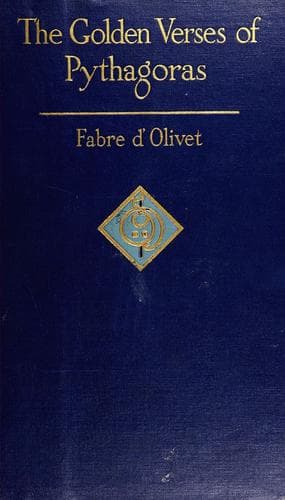
The golden verses of PythagorasFabre d'Olivet, Antoine
Religion
The golden verses of Pythagoras
Fabre d'Olivet, Antoine
Poetry -- History and criticism; Pythagoras and Pythagorean school
head beneath the yoke of the king of Macedonia.
This king, victor at Chæronea, became arbiter of Greece, and his son,
providential instrument of the ascendancy which Europe was to have
over Asia, crossing the Hellespont at the head of an army that his
genius alone rendered formidable, overthrew the empire of Cyrus and
stood for a moment upon its débris: I say for a moment, because it was
not here that the new empire was to be established: Europe had still
obeyed; she was one day to command. Rome was already, in the thought
of the future, the culminating point of the earth. A few centuries
sufficed for this city, then unknown,[173] to attain to the height of
glory. Emerging from her obscurity, conquering Pyrrhus, dominating
Italy, combating and overthrowing Carthage, conquering Greece, and
trampling under foot twenty diadems borne by the successors of
Alexander, was for this ambitious Republic the work of a few
centuries. But it is not true, although certain men whose virtue was
not enlightened by the torch of experience may have been able to say
it; it is not true that a republic, already perplexed in governing
itself, can govern the world. It requires an empire, and this empire
is created.
Cæsar laid its foundation, Augustus strengthened it. The sciences and
arts, brought to Rome from the heart of Greece, came out then from
their lethargy and flourished with a new _éclat_. Poetry, especially,
found numberless admirers. Vergil, strongly attracted by the magnetic
flame of Homer, dared to tread in his light, overthrew all the
obstacles that time had raised, and drawing near to this divine model,
received from him the second inspiration without intermediary and
without rival. Ovid, less determined, hovering between Orpheus and
Homer, succeeded, however, in uniting the second inspiration of the
one to the third inspiration of the other, and left in his book of
_Metamorphoses_ a monument not less brilliant and more inimitable than
the _Æneid_. Horace, little satisfied with succeeding Pindar, sought
and found the means of uniting to the enthusiasm of the passions the
calm of rational poetry, and, establishing himself a legislator of
Parnassus, dictated laws to the poets, or jeered at the absurdities of
men.
Public-domain text, read in full here on John Shaqi.
Reviews
Reviews
No reviews yet
Be the first to share your thoughts on this work.
Join the Discussion
Join the discussion
Sign in to leave a comment or review.
Sign InorCreate an account