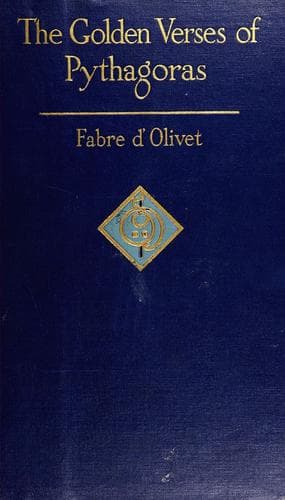
The golden verses of PythagorasFabre d'Olivet, Antoine
Religion
The golden verses of Pythagoras
Fabre d'Olivet, Antoine
Poetry -- History and criticism; Pythagoras and Pythagorean school
When I compare Shakespeare with Æschylus, I want to make it clearly
understood that I regard him as the regenerator of the theatre in
Europe, and superior to Corneille and Racine as to dramatic essence,
although he may be assuredly much inferior to them as to form.
Æschylus, in Greek, was inspired by Homer; while, on the contrary, it
was Shakespeare who inspired Milton. It is known that _Paradise Lost_
was at first conceived as the subject of a tragedy, and that it was
only after reflection that the English poet saw therein the material
for an epic poem. I will tell later on, in speaking of the _Messiah_
of Klopstock, what has prevented these two subjects, which appear
equally epics, from attaining wholly to the majesty of epopœia. As
many of the motives that I have to offer apply to the two works, I
will thus avoid useless repetition. I shall begin by translating the
exposition and invocation of Milton, by imitating its movement and its
harmony, as I have done with the other poets.
De l’homme, viens chanter la disgrâce, et la fruit
De cet arbre fatal, dont le goût homicide
Livra le Monde au crime, à la mort, aux malheurs,
Et nous ravit Eden, jusqu’au moment qu’un Homme
Plus grand, par son trépas, racheta le séjour
Du bonheur: viens, ô Muse! ô toi qui, sur la cime
Se Sinaï, d’Oreb, en secret inspiras
La Berger d’Israël, quand d’une voix sacrée
Il enseignait comment et la terre et des cieux
Sortirent du Chaos! ou bien, si tu préfères
Les sommets de Sion, les bords du Siloë,
Qui, près du Temple saint, roule ses flots, ô Muse!
Viens protéger de là mes chants audacieux,
Mes chants qui, surpassant d’un essor non timide,
Les monts Aoniens, vont raconter des faits
Que n’ont point encor dits la prose ni la rime.
Of Man’s first disobedience, and the fruit
Of that forbidden tree, whose mortal taste
Brought death into the world, and all our woe,
With loss of Eden, till one greater Man
Restore us and regain the blissful seat,
Sing, heavenly Muse, that, on the secret top
Of Oreb or of Sinai, didst inspire
That shepherd, who first taught the chosen seed,
In the beginning how the heavens and earth
Rose out of chaos; or if Sion hill
Delight thee more, and Siloa’s brook that flow’d
Fast by the oracle of God; I thence
Invoke thy aid to my adventurous song,
That with no middle flight intends to soar
Above the Aonian mount, while it pursues
Things unattempted yet in prose or rhyme.
Public-domain text, read in full here on John Shaqi.
Reviews
Reviews
No reviews yet
Be the first to share your thoughts on this work.
Elsewhere in the archive
Join the Discussion
Join the discussion
Sign in to leave a comment or review.
Sign InorCreate an account