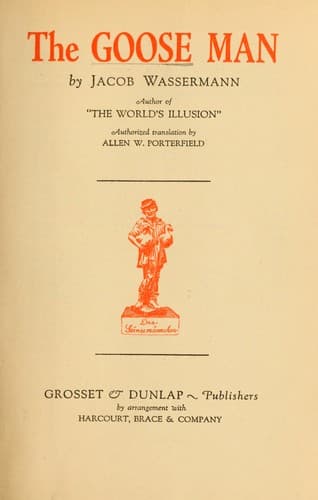
Composers -- Fiction; German fiction -- Translations into English; Germany -- Fiction
“Just at the right time,” murmured the old Baron, without looking up and
as if lost in meditation, “just at the right time.”
Eberhard made no reply. He stood as still, as motionless, as silent, and
with his heels as close together as if he were a young officer facing
his superior in command.
After a while he wheeled about and slowly left the room.
Sylvia was waiting in the library. In the twilight it was possible to
see only the vague outline of her body.
Eberhard took hold of her and whispered: “I really believe that I no
longer have a father.”
VI
That same night the old Baron had left. He got up in the middle of the
night; at four o’clock his valet accompanied him to the station.
The next morning two letters were found lying on his writing desk: one
was addressed to Eberhard, the other to the Baroness. The latter
contained nothing more than a few words of farewell. The former was more
detailed. It expressed the Baron’s satisfaction at the fact that
Eberhard, whom he welcomed as the head of the house, had returned, and
plainly indicated that all the necessary legal steps would be taken in a
very short while to give him complete authority as his heir and
successor. The letter closed with this surprising sentence: “So far as I
am personally concerned, I am planning to enter the Catholic Church, in
order to spend the remainder of my misapplied life at Viterbo in the
Dominican Convent of Della Guercia.”
There was no explanation, no unusual display of feeling, no confession,
nothing but the naked fact.
The Baroness was neither surprised nor shocked. She fell into a mute,
melancholy brooding, and then said: “He never was happy, never in his
whole life. I never heard him laugh a really whole-souled laugh; and
living with him has made me forget how to laugh myself. His heart has
been from time immemorial a sort of convent, an abode of darkness, a
place of sternness. He has found his way home at last, and is probably
tired from the long journey on the way to his soul.”
“Nonsense, Clotilda!” cried Frau von Erfft. “What you say about his
laughing may be true, and a man who cannot laugh is half animal. But do
you mean to tell me that an intelligent man must resort to such means to
find peace with himself and his God? A man who is under obligations to
set an example for others? Is there not enough darkness in men’s heads
already? Is it necessary to put out the torches of those who stand
guard? My sense of pardon is not so elaborate. I prefer to be a child of
the world and associate with those who are regarded as heathens, and who
have given us works of light and illumination.”
At these words Eberhard entered. As she looked into his face, Frau von
Erfft thought: “There is another who can’t laugh.”
Public-domain text, read in full here on John Shaqi.
Reviews
Reviews
No reviews yet
Be the first to share your thoughts on this work.
Elsewhere in the archive
Join the Discussion
Join the discussion
Sign in to leave a comment or review.
Sign InorCreate an account