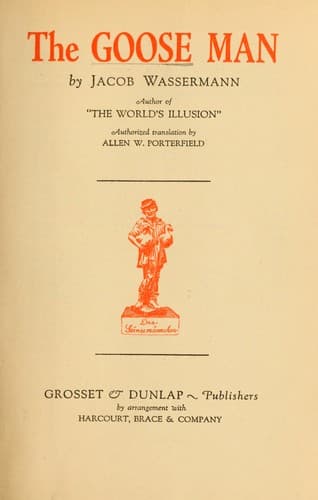
Composers -- Fiction; German fiction -- Translations into English; Germany -- Fiction
Herr Carovius was not spoiled. Since the days his sister had kept house
for him, no woman had ever concerned herself about him in the least. But
at that time he was young; and he had wheedled himself into believing
that the women were merely waiting for him, that all he had to do was to
beckon to them with his finger and they would come rushing up to him in
battalions. But because he had dreaded the idea of making an unhappy
selection, and by reason of the expense of the enterprise, he had
neglected to give the necessary signal, and hence had been so generous
as to leave them in complete possession of their freedom.
He never knew until now that the soft, little hand of a woman could
bring out effects as if they had come from the touch of a magic wand.
“What a pleasant little phiz Döderlein’s offspring has,” he thought. And
if Dorothea, who had made him believe that she was visiting him on the
sly, though her father had given his consent long ago, chanced to remain
away for a few days, he would become wild with rage, and go into the
kitchen and chop wood merely to enjoy the sensation of destroying
something.
Moreover, the music lessons Dorothea was taking at Herr Carovius’s
expense gave the girl a new conception of her art, and awakened in her a
measure of wholesome ambition. Satisfied as he was with her docility and
her progress, Herr Carovius referred to her at times as the coming
female Paganini, and pictured himself in the rôle of a demoniacal
impresario.
But the thing about Dorothea that struck him most forcibly and filled
him with such astonishment was her relation to mirrors.
A mirror exercised a tremendous influence on her. If she passed by one,
her face became coloured with a charming blush of desire; if she stood
before one and saw her picture reflected in it, she was filled, first
with sexual unrest, and then with retreating uncertainty. In the
brightness of her eyes there was always a longing for the mirror. Her
gait and her gestures seemed to have duties imposed on them by the
mirror; it seemed to be their task to prepare surprises. Her whole body
seemed to live in common with a spectral mirror sister, and to catch
sight of this beloved sister was her first wish, fulfilment of which she
effected as often as possible.
VIII
Dorothea had succeeded in making it clear to her father that it would be
highly advantageous to her, as the nearest relative, to show Herr
Carovius every conceivable favour. Andreas Döderlein baulked at first;
but he could not refuse recognition to the far-seeing penetration of his
daughter.
When she told him of her appearance in the baronial residence, and
mentioned the enormous sum Herr Carovius had collected with the mien of
an undaunted victor, Döderlein became serious; he stared into space and
did some hard thinking. Recalling the now superannuated feud, he
preserved the appearance of inapproachability, and said: “We will not
debase ourselves for the sake of Mammon.”
Public-domain text, read in full here on John Shaqi.
Reviews
Reviews
No reviews yet
Be the first to share your thoughts on this work.
Elsewhere in the archive
Join the Discussion
Join the discussion
Sign in to leave a comment or review.
Sign InorCreate an account