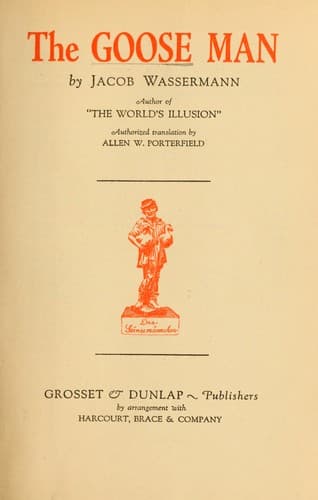
Composers -- Fiction; German fiction -- Translations into English; Germany -- Fiction
Eleanore’s funeral took place on a rainy June day. Herr Carovius,
dressed in his shabby old yellow raincoat with its big pockets, was
present. There were also many others present. Every face was touched
with grief; every eye was filled with tears, like the earth round about.
Those who had not known her had at least heard of her. They had known
that she had been there in some capacity, just as one hears of some
unusual phenomenon among the celestial bodies, and that she was gone;
that she was no more to be seen. For one moment at least all these
people were changed into deep, seeing, feeling beings; for one moment
they laid aside their fruitless activities, their petty misdeeds,
desires, anxieties, and vanities, and became conscious of the fact that
the truth, purity, love, and loveliness of this earth had been
decreased.
Herr Carovius went home and made a lime-blossom tea; such a tea had
often helped him when he had not felt well.
The rain dripped down on the kitchen window sill. Herr Carovius said to
himself: “That is my last funeral.”
Along in the evening Dorothea came in and after her Philippina
Schimmelweis. Herr Carovius had paid her many a penny for her services
as a spy, and now she wanted to hear what he had to say to this last and
greatest of misfortunes. His infatuated interest in everything Eleanore
did had been a source of unmitigated pleasure to her, though she had
been exceedingly cautious never to let him see how she felt about it
all. On the contrary, she never failed to affect a hypocritical
seriousness in the face of all his questions, orders, instructions, and
caustic observations. She had egged him on; she had flattered him; she
had used every opportunity to fan the flames of his ridiculous hopes.
Owing to this the confidence between the two had grown to considerable
proportion; the man’s senile madness, born of his love for Eleanore, had
even aroused Philippina’s lewd lasciviousness.
She said she would have to be going home; the child was asleep; and
though she had locked the front door, you could never tell what was
going to happen over there. “My God,” she said, “things take place in
that house that are never heard of in any other home.”
The presence of Dorothea disturbed and annoyed her. She sat down on the
kitchen bench, and looked at the young girl with poison in her eyes.
Dorothea on the other hand found it painfully difficult to conceal her
disgust at the mere sight of Philippina: her ugliness defied descriptive
adjectives. Dorothea never took her eyes off the creature who sat there
talking in a screeching voice, and who, as if her normal
unattractiveness were not enough, had her head bandaged.
The fact is that Philippina had the toothache; for this reason her face
was wrapped in a loud, checkered cloth, while out from underneath her
hat stuck two little tassels.
Public-domain text, read in full here on John Shaqi.
Reviews
Reviews
No reviews yet
Be the first to share your thoughts on this work.
Elsewhere in the archive
Join the Discussion
Join the discussion
Sign in to leave a comment or review.
Sign InorCreate an account