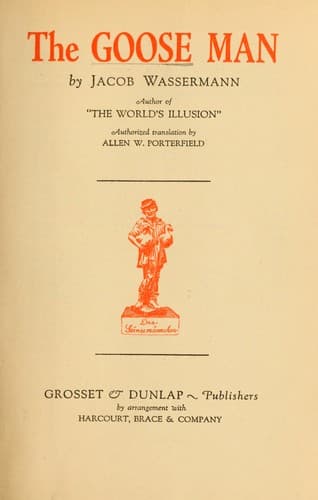
Composers -- Fiction; German fiction -- Translations into English; Germany -- Fiction
Owing to her desire to find consolation of some kind and at any price,
she turned to Eberhard and Sylvia; they were now visiting Daniel almost
every day. She liked them; there was so much consideration for other
people in their behaviour, so much delicacy and refinement in their
conversation. Sylvia was not in the least offended by Daniel’s sullen
silence; she treated him with a respect and deference that made Marian
feel good; for it was proof to her that in the eyes of good and noble
people Daniel stood in high esteem. The Baron seemed in some mysterious
way to be continually talking about Eleanore, though he never mentioned
her name. There was a sadness in his eyes that reminded her of Eleanore;
there was something supersensuous in its power. Marian often felt as
though this strange nobleman and her son were brothers and at the same
time enemies, as seen in the light of painful memories. Sylvia also
seemed to have the same feeling; but she found nothing objectionable in
the relation.
One day, as Marian accompanied the two to the hall door, she decided to
pick up her courage; and she did. “Well, how do you think he is going to
make out?” she asked; “he has no work; as a matter of fact he never
speaks of work. What will that lead to?”
“We have been thinking about that,” replied Sylvia, “and I believe a way
has been found to help him. He will hear about it in a short while. But
he must not suspect that we have anything to do with it.” She looked at
her fiancé; he nodded approvingly.
Eberhard and Sylvia knew perfectly well from the very beginning that
there could be no thought of lending Daniel money. Gifts, large or
small, merely humiliated him; they disgraced him. It was a case where
eagerness to serve on the part of those who have meets with
insurmountable obstacles, whether they wish to be lavish in their
generosity or of seeming calculation. There was no use to appeal to
delicacy; attenuating provisos would not help; small deceptions
practised in the spirit of love would prove ineffectual. Riches stood
face to face with poverty, and was as helpless as poverty usually is
when obliged to enter the lists against riches. The case was striking,
but not unique.
Having made up her mind to come to the assistance of the musician,
Sylvia turned to her mother. But it was idle to count on the backing of
the Baroness: Andreas Döderlein had so poisoned her mind against Daniel
that the mere mention of his name caused her brow to wrinkle, her lips
to drop.
Agatha von Erfft got in touch, by letter, with some business people who
were in a position to give her some practical advice. Their assistance
was helpful in that it at least saved her the invaluable time she might
have lost by appealing to the wrong people. One day she appeared before
Eberhard and Sylvia with her plans all drawn up.
Public-domain text, read in full here on John Shaqi.
Reviews
Reviews
No reviews yet
Be the first to share your thoughts on this work.
Elsewhere in the archive
Join the Discussion
Join the discussion
Sign in to leave a comment or review.
Sign InorCreate an account