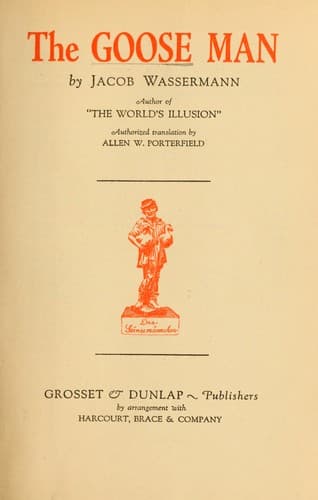
Composers -- Fiction; German fiction -- Translations into English; Germany -- Fiction
She told him of her life, wrote of the books she had read, the people
she had met, and gave him her views on music. Her communications became
in time indispensable to him; he was touched by her fidelity; he was
pleased that she did not use her own name. She had a remarkable finesse
and power of expression, and however ungenuine and artificial she may
have appealed to him in personal association, everything she wrote
seemed to him to be natural and convincing. She never expressed a wish
that he do something impossible and never uttered a complaint. On the
other hand, there was a passion of the intelligence about her that was
quite new to him; she was unlike the women he had known. And there was a
fervour and certainty in her appreciation of his being before which he
bowed as at the sound of a higher voice.
Though he never answered her letters, he looked forward to receiving
them, and became impatient if one were overdue. He often thought of the
swallow when he would step to the window on a dark night. He thought of
her as an all-seeing spirit that hovered in the air. The swallow—that
was fraught with meaning—the restless, delicate, swift-flying swallow.
And in his mind’s eye he saw the swallow that hovered over Ægydius Place
when Eberhard came to take him up to the room with the withered flowers.
He wrote to Philippina: “Decorate my graves. Buy two wreaths, and lay
them on the graves.”
“You must mount to the clouds, Daniel, otherwise you are lost,” was one
passage in one of the letters from the Swallow. Another, much longer,
ran: “As soon as you feel one loneliness creeping over you, you must
hasten into another, an unknown one. If your path seems blocked, you
must storm the hedges before you. If an arm surrounds you, you must tear
yourself loose, even though it cost blood and tears. You must leave men
behind and move above them; you dare not become a citizen; you dare not
allow yourself to be taken up with things that are dear to you; you must
have no companion, neither man nor maid. Time must hover over you cold
and quiet. Let your heart be encased in bronze, for music is a flame
that breaks through and consumes all there is in the man who created it,
except the stuff the gods have forged about their chosen son.”
Why should the picture of this red-haired Jewess, from whom Daniel had
fled in terror, not have vanished? There was a Muse such as poets dream
of! “Jewess, wonderful Jewess,” thought Daniel, and this
word—Jewess—took on for him a meaning, a power, and a prophetic flight
all its own.
Public-domain text, read in full here on John Shaqi.
Reviews
Reviews
No reviews yet
Be the first to share your thoughts on this work.
Elsewhere in the archive
Join the Discussion
Join the discussion
Sign in to leave a comment or review.
Sign InorCreate an account