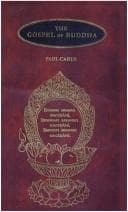
The Gospel of Buddha, Compiled from Ancient Records — John Shaqi
The Gospel of Buddha, Compiled from Ancient RecordsCarus, Paul
ReligionEastern
The Gospel of Buddha, Compiled from Ancient Records
Carus, Paul
Buddhism; Christianity and other religions -- Buddhism; Gautama Buddha; Gautama Buddha -- Teachings
THE GOSPEL OF BUDDHA
COMPILED FROM ANCIENT RECORDS
BY
PAUL CARUS
ILLUSTRATED
BY
O. KOPETZKY
CHICAGO and LONDON
THE OPEN COURT PUBLISHING COMPANY
1915
PREFACE.
This booklet needs no preface for those who are familiar with the sacred
books of Buddhism, which have been made accessible to the Western world
by the indefatigable zeal and industry of scholars like Beal, Bigandet,
Bühler, Burnouf, Childers, Alexander Csoma, Rhys Davids, Dutoit, Eitel,
Fausböll, Foucaux, Francke, Edmund Hardy, Spence Hardy, Hodgson, Charles
R. Lanman, F. Max Müller, Karl Eugen Neumann, Oldenberg, Pischel,
Schiefner, Senart, Seidenstücker, Bhikkhu Nyānatiloka, D.M. Strong,
Henry Clarke Warren, Wassiljew, Weber, Windisch, Winternitz &c. To those
not familiar with the subject it may be stated that the bulk of its
contents is derived from the old Buddhist canon. Many passages, and
indeed the most important ones, are literally copied in translations
from the original texts. Some are rendered rather freely in order to
make them intelligible to the present generation; others have been
rearranged; and still others are abbreviated. Besides the three
introductory and the three concluding chapters there are only a few
purely original additions, which, however, are neither mere literary
embellishments nor deviations from Buddhist doctrines. Wherever the
compiler has admitted modernization he has done so with due
consideration and always in the spirit of a legitimate development.
Additions and modifications contain nothing but ideas for which
prototypes can be found somewhere among the traditions of Buddhism, and
have been introduced as elucidations of its main principles.
The best evidence that this book characterizes the spirit of Buddhism
correctly can be found in the welcome it has received throughout the
entire Buddhist world. It has even been officially introduced in
Buddhist schools and temples of Japan and Ceylon. Soon after the
appearance of the first edition of 1894 the Right Rev. Shaku Soyen, a
prominent Buddhist abbot of Kamakura, Japan, had a Japanese translation
made by Teitaro Suzuki, and soon afterwards a Chinese version was made
by Mr. Ohara of Otzu, the talented editor of a Buddhist periodical, who
in the meantime has unfortunately met with a premature death. In 1895
the Open Court Publishing Company brought out a German edition by E.F.L.
Gauss, and Dr. L. de Milloué, the curator of the Musée Guimet, of Paris,
followed with a French translation. Dr. Federigo Rodriguez has
translated the book into Spanish and Felix Orth into Dutch. The
privilege of translating the book into Russian, Czechic, Italian, also
into Siamese and other Oriental tongues has been granted, but of these
latter the publishers have received only a version in the Urdu language,
a dialect of eastern India.
Public-domain text, read in full here on John Shaqi.
Reviews
Reviews
No reviews yet
Be the first to share your thoughts on this work.
Join the Discussion
Join the discussion
Sign in to leave a comment or review.
Sign InorCreate an account