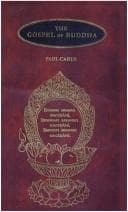
The Gospel of Buddha, Compiled from Ancient RecordsCarus, Paul
ReligionEastern
The Gospel of Buddha, Compiled from Ancient Records
Carus, Paul
Buddhism; Christianity and other religions -- Buddhism; Gautama Buddha; Gautama Buddha -- Teachings
The Blessed One said: "Jinas are all those who have conquered
self and the passions of self, those alone are victors who
control their minds and abstain from evil. Therefore, Upaka, I am
the Jina." 6
Upaka shook his head. "Venerable Gotama," he said, "thy way lies
yonder," and taking another road, he went away. 7
XVI.
THE SERMON AT BENARES.
On seeing their old teacher approach, the five bhikkhus agreed
among themselves not to salute him, nor to address him as a
master, but by his name only. "For," so they said, "he has broken
his vow and has abandoned holiness. He is no bhikkhu but Gotama,
and Gotama has become a man who lives in abundance and indulges
in the pleasures of worldliness." 1
But when the Blessed One approached in a dignified manner, they
involuntarily rose from their seats and greeted him in spite of
their resolution. Still they called him by his name and addressed
him as "friend Gotama." 2
When they had thus received the Blessed One, he said: "Do not
call the Tathāgata by his name nor address him as 'friend,' for
he is the Buddha, the Holy One. The Buddha looks with a kind
heart equally on all living beings, and they therefore call him
'Father.' To disrespect a father is wrong; to despise him, is
wicked. 3
"The Tathāgata," the Buddha continued, "does not seek salvation
in austerities, but neither does he for that reason indulge in
worldly pleasures, nor live in abundance. The Tathāgata has found
the middle path. 4
"There are two extremes, O bhikkhus, which the man who has given
up the world ought not to follow--the habitual practice, on the
one hand, of self-indulgence which is unworthy, vain and fit only
for the worldly-minded--and the habitual practice, on the other
hand, of self-mortification, which is painful, useless and
unprofitable. 5
"Neither abstinence from fish or flesh, nor going naked, nor
shaving the head, nor wearing matted hair, nor dressing in a
rough garment, nor covering oneself with dirt, nor sacrificing to
Agni, will cleanse a man who is not free from delusions. 6
"Reading the Vedas, making offerings to priests, or sacrifices to
the gods, self-mortification by heat or cold, and many such
penances performed for the sake of immortality, these do not
cleanse the man who is not free from delusions. 7
"Anger, drunkenness, obstinacy, bigotry, deception, envy,
self-praise, disparaging others, superciliousness and evil
intentions constitute uncleanness; not verily the eating of
flesh. 8
Public-domain text, read in full here on John Shaqi.
Reviews
Reviews
No reviews yet
Be the first to share your thoughts on this work.
Join the Discussion
Join the discussion
Sign in to leave a comment or review.
Sign InorCreate an account