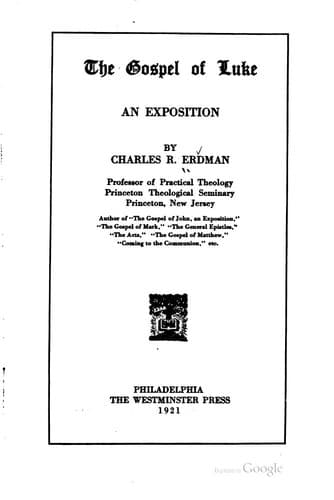
The Gospel of Luke, an expositionErdman, Charles Rosenbury
Religion
The Gospel of Luke, an exposition
Erdman, Charles Rosenbury
Bible. Luke -- Commentaries
As Jesus was journeying on toward Jerusalem the attending crowds were
increasing in size and in excitement. The people imagined that he was
about to establish a kingdom in pomp and splendor and power, and in these
glories they expected to share. To remove the misunderstanding, Jesus
turned to declare the true conditions of discipleship. His followers must
expect sacrifice and suffering and be willing to part with all they
possessed, even with life itself. When he declared that they must hate
their kindred and their own lives, he of course meant that they must love
them less than they loved him, regarding them with aversion only in so far
as they were opposed to him or stood in the way of his service. To be his
disciple one must be willing to “bear his own cross,” which was a symbol
of suffering and of death; one must continually yield his will to the will
of Christ, no matter what hardship or loss might be involved.
Jesus did not wish to discourage men from following him, but warned them
first to count the cost. This he illustrated by referring to the folly of
laying the foundation for a building without first estimating the entire
expense and one’s ability to meet it; he also stated, as a further
illustration, the rashness of entering a war without first calculating
what sacrifices must be made to win. Jesus did not mean that it is better
not to begin the Christian life than to begin and fail, but that it is not
wise even to begin unless one first realizes that it involves a readiness
to renounce everything which the service of Christ may demand. “So
therefore whosoever he be of you that renounceth not all that he hath, he
cannot be my disciple.”
Nothing could be more useless than a worldly and selfish and willful
follower of Christ; he is like salt that has lost its savor; he lacks the
very essence of discipleship; he can be of no possible service to his
Lord.
5. The Prodigal Son. Ch. 15
1 Now all the publicans and sinners were drawing near unto him to
hear him. 2 And both the Pharisees and the scribes murmured,
saying, This man receiveth sinners, and eateth with them.
3 And he spake unto them this parable saying, 4 What man of you,
having a hundred sheep, and having lost one of them, doth not
leave the ninety and nine in the wilderness, and go after that
which is lost, until he find it? 5 And when he hath found it, he
layeth it on his shoulders, rejoicing. 6 And when he cometh home,
he calleth together his friends and his neighbors, saying unto
them, Rejoice with me, for I have found my sheep which was lost. 7
I say unto you, that even so there shall be joy in heaven over one
sinner that repenteth, _more_ than over ninety and nine righteous
persons, who need no repentance.
Public-domain text, read in full here on John Shaqi.
Reviews
Reviews
No reviews yet
Be the first to share your thoughts on this work.
Elsewhere in the archive
Join the Discussion
Join the discussion
Sign in to leave a comment or review.
Sign InorCreate an account