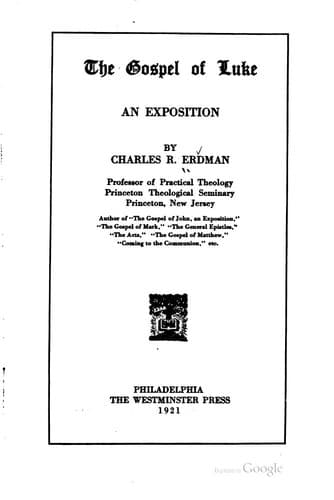
The Gospel of Luke, an expositionErdman, Charles Rosenbury
Religion
The Gospel of Luke, an exposition
Erdman, Charles Rosenbury
Bible. Luke -- Commentaries
In describing the waywardness of this younger son, Jesus gave a complete
picture of the character and consequences of sin. Some have thought that
the parable of the Lost Sheep indicates that sin is due in part to
ignorance and folly and that the parable of the Lost Coin shows that it
may be occasioned by misfortune or accident. The parable of the Prodigal
Son, however, shows that it is usually due to willful choice and to a
desire for indulgence. Its results are sketched in appalling colors. We
are shown all its disillusion, suffering, slavery, and despair. As a
picture of the inevitable consequences of sin, no touch could be added to
the scene of the prodigal in the far country when he had spent all, when
the famine had arisen, when he had sold himself to feed swine and was
unable to be satisfied even with the coarse food he was providing for
beasts.
Nor is there any more beautiful picture of repentance than was drawn when
the Master described the prodigal as “he came to himself,” his sin had not
been mere folly, it had been madness. He remembered a former time of joy
and plenty in his early home. He realized his present desperate need; he
resolved to arise and go to his father. Most of all, he saw that his
offense had been not only against a loving, earthly parent but against
God, and that he was wholly undeserving of fellowship with his father.
Repentance is not only sorrow for sin; it is an acknowledgment that the
offense has been committed against a holy God; it is a change of heart
toward him, and a resolution for a new life which manifests itself in
definite action. “He arose, and came to his father.”
Strictly speaking, this is the end of the parable of the Prodigal Son. In
another sense the most beautiful part immediately follows. It is a
description of the matchless love shown by God to every repentant soul.
The father had never ceased to love the prodigal or to hope and yearn for
his return. He had been eagerly looking for his wayward son. The first
sight of the prodigal filled his heart with compassion; he “ran, and fell
on his neck, and kissed him.” The prodigal was ready to confess his fault,
but the father scarcely heard his words as he commanded the servants to
“bring forth quickly the best robe, and put it on him; and put a ring on
his hand, and shoes on his feet: and bring the fatted calf, and kill it,
and let us eat, and make merry.” It is a picture not only of pardon but of
complete restoration. It assures the sinner that as he turns to God he
will be received into the closest fellowship of a son and heir and that
his return will give joy to the heart of God who will regard him as one
that “was dead, and is alive again,” as one who “was lost, and is found.”
Public-domain text, read in full here on John Shaqi.
Reviews
Reviews
No reviews yet
Be the first to share your thoughts on this work.
Elsewhere in the archive
Join the Discussion
Join the discussion
Sign in to leave a comment or review.
Sign InorCreate an account