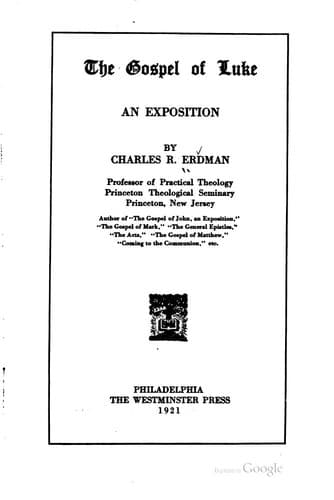
The Gospel of Luke, an expositionErdman, Charles Rosenbury
Religion
The Gospel of Luke, an exposition
Erdman, Charles Rosenbury
Bible. Luke -- Commentaries
The picture of the elder son is exquisitely sketched. It was
unquestionably intended to describe the loveless Pharisees who envied the
joy of the repentant publicans and sinners. It furthermore brings a
message to all persons in every age to whom religion is merely a matter of
unwilling obedience and of loveless faithfulness to the laws of God. It
depicts souls out of fellowship with God, feeling no real joy in his
service and sharing none of his gladness in the salvation of lost souls.
The elder brother knew nothing of the experience of a true son. He was
merely a slave. When the prodigal returned he was not watching with his
father, he was “in the field;” when he learned that his brother had been
welcomed to the home he was filled with anger. He refused to enter the
house and when his father came out to entreat him, he accused him of
partiality and unkindness. His words described admirably the
self-righteousness of the Pharisees, “I never transgressed a commandment
of thine;” they also show how little he appreciated his true privileges,
“thou never gavest me a kid.” The reply of his father intimates the
possibilities which he never had appreciated and the privileges which he
never had enjoyed, “Son, thou art ever with me, and all that is mine is
thine.” It had always been possible for the Pharisees to enjoy the grace
and mercy and love of God; but to them religion had been a mere burdensome
round of rites and duties. It had given no satisfaction, no gladness, to
their hearts. Something of their experience is paralleled even by
Christians of the present day. Failing to appreciate the gracious pardon
of God and his willingness to supply every spiritual need, forgetting the
possibility of living in daily communion and fellowship with him, knowing
nothing of his joys in the salvation and repentance of lost souls, they
are seeking in their own strength, wearily and joylessly, to do the things
that they believe to be right and to obey the commands of God, but their
lives are like those of servants, not like the free, joyous, loving
experience of true sons.
Possibly the most artistic touch in the parable is its abrupt close. We do
not know whether the elder son yielded to the entreaty of his father or
not. It was an appeal to the Pharisees; would they accept the grace of God
and further his plans for the salvation of the lost, or would they
continue to criticize and envy the repentant sinner? Shall we live as
servants or as sons?
6. The Unrighteous Steward. Ch. 16:1-13
Public-domain text, read in full here on John Shaqi.
Reviews
Reviews
No reviews yet
Be the first to share your thoughts on this work.
Elsewhere in the archive
Join the Discussion
Join the discussion
Sign in to leave a comment or review.
Sign InorCreate an account