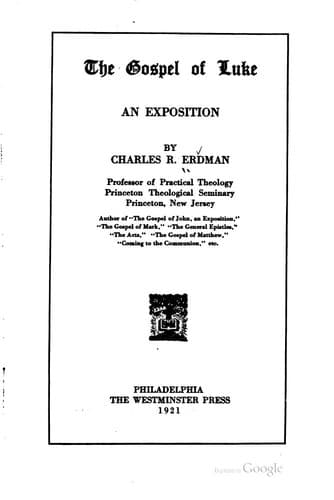
The Gospel of Luke, an expositionErdman, Charles Rosenbury
Religion
The Gospel of Luke, an exposition
Erdman, Charles Rosenbury
Bible. Luke -- Commentaries
The story is that of a steward or a trustee who was in charge of the
property of a rich landowner. Report had reached his master of the
extravagance and dishonesty of this servant. An account was demanded and
he was certain to lose his position. However, he seized on the opportunity
which was still his so to use the wealth intrusted to him as to secure
friends who would provide a home for him when his stewardship had been
lost.
The story is intended to illustrate the stewardship of wealth. No money is
really owned by a follower of Christ; it is simply intrusted to him to be
wisely used in accordance with the will of the Master. For its use a
strict account must some day be made. It will, therefore, be the part of
wisdom and of prudence so to use that which is now intrusted that in the
eternity to come there will be no regret but only joy for the way in which
wealth was employed. In the parable the steward was guilty of fraud, as he
reduced the debts of those who owed money to his master. He was really
using for his future benefit money which was not his own. Of course the
Christian is to act with scrupulous honesty; nevertheless, as he benefits
others by his generous gifts, he really is using money which belongs to
the Lord, but of course he is using it in accordance with the will of his
Master.
In applying the parable, Jesus indicated that the right use of money,
which seeks the welfare of others, applies not only to the rich but also
to the poor, “He that is faithful in a very little is faithful also in
much.”
Jesus further indicated that the stewardship which all Christians now
enjoy is a training for larger service in the life to come. “If therefore
ye have not been faithful in the unrighteous mammon, who will commit to
your trust the true riches?”
The motive which inspires fidelity as stewards is that of love. The
difficulty with the dishonest servant was that he was disloyal to his
master and was really seeking to serve himself. One who really loves his
Lord will be faithful in the use of that which is intrusted to him. The
danger of stewards is that of divided allegiance. “No servant can serve
two masters: for either he will hate the one, and love the other; or else
he will hold to one, and despise the other. Ye cannot serve God and
mammon.”
7. The Rich Man and Lazarus. Ch. 16:14-31
14 And the Pharisees, who were lovers of money, heard all these
things; and they scoffed at him. 15 And he said unto them, Ye are
they that justify yourselves in the sight of men; but God knoweth
your hearts: for that which is exalted among men is an abomination
in the sight of God. 16 The law and the prophets _were_ until
John: from that time the gospel of the kingdom of God is preached,
and every man entereth violently into it. 17 But it is easier for
heaven and earth to pass away, than for one tittle of the law to
fall.
Public-domain text, read in full here on John Shaqi.
Reviews
Reviews
No reviews yet
Be the first to share your thoughts on this work.
Elsewhere in the archive
Join the Discussion
Join the discussion
Sign in to leave a comment or review.
Sign InorCreate an account