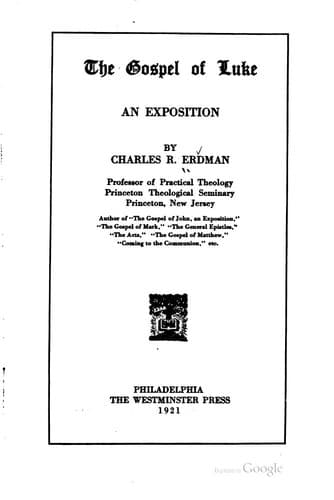
The Gospel of Luke, an expositionErdman, Charles Rosenbury
Religion
The Gospel of Luke, an exposition
Erdman, Charles Rosenbury
Bible. Luke -- Commentaries
1 And he said also unto the disciples, There was a certain rich
man, who had a steward; and the same was accused unto him that he
was wasting his goods. 2 And he called him, and said unto him,
What is this that I hear of thee? render the account of thy
stewardship; for thou canst be no longer steward. 3 And the
steward said within himself, What shall I do, seeing that my lord
taketh away the stewardship from me? I have not strength to dig;
to beg I am ashamed. 4 I am resolved what to do, that, when I am
put out of the stewardship, they may receive me into their houses.
5 And calling to him each one of his lord’s debtors, he said to
the first, How much owest thou unto my lord? 6 And he said, A
hundred measures of oil. And he said unto him, Take thy bond, and
sit down quickly and write fifty. 7 Then said he to another, And
how much owest thou? And he said, A hundred measures of wheat. He
saith unto him, Take thy bond, and write fourscore.
8 And his lord commended the unrighteous steward because he had
done wisely: for the sons of this world are for their own
generation wiser than the sons of the light. 9 And I say unto you,
Make to yourselves friends by means of the mammon of
unrighteousness; that, when it shall fail, they may receive you
into the eternal tabernacles. 10 He that is faithful in a very
little is faithful also in much: and he that is unrighteous in a
very little is unrighteous also in much. 11 If therefore ye have
not been faithful in the unrighteous mammon, who will commit to
your trust the true _riches_? 12 And if ye have not been faithful
in that which is another’s, who will give you that which is your
own? 13 No servant can serve two masters: for either he will hate
the one, and love the other; or else he will hold to one, and
despise the other. Ye cannot serve God and mammon.
The parable of the Unrighteous Steward is often regarded as the most
perplexing of all the parables of our Lord. It seems to picture a man who
robbed his master and received his master’s praise and was pointed to by
Jesus as an example for his followers; further, it seems to indicate that
a place in heaven can be purchased with money. A more careful reading
shows that the praise was bestowed, not for dishonesty, but for prudence
and foresight, that our Lord would have his followers imitate these good
qualities in a bad man, and further that it is possible to use wealth so
generously as to secure endless satisfaction and joy.
Public-domain text, read in full here on John Shaqi.
Reviews
Reviews
No reviews yet
Be the first to share your thoughts on this work.
Elsewhere in the archive
Join the Discussion
Join the discussion
Sign in to leave a comment or review.
Sign InorCreate an account