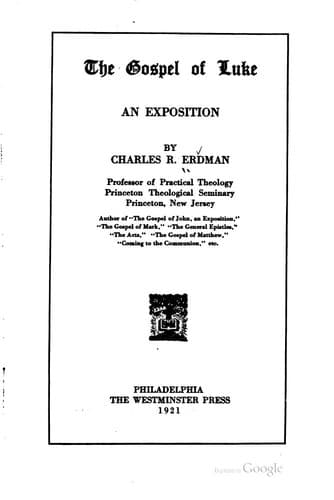
The Gospel of Luke, an expositionErdman, Charles Rosenbury
Religion
The Gospel of Luke, an exposition
Erdman, Charles Rosenbury
Bible. Luke -- Commentaries
The particular force of the parable relates, however, to the Church in her
conscious weakness and loneliness, in the age between the crucifixion and
the second coming of Christ. Jesus had just given a description of the
world at the time of his return. He had pictured the prevalent
carelessness and indifference and absorption in earthly pursuits, and now
he wished to encourage his followers to be patient and to turn their
hearts toward him in expectation and prayer. The widow in the parable is
not so much requesting that an enemy should be punished as that she should
be given her property rights for which she is applying to the judge. So
the Church is pictured, not simply as crying for vengeance upon
persecutors, but rather as longing and praying for all those blessings
which have been promised and which will be received at the coming of the
Lord.
There is a deep mournfulness in the question which Jesus asked after
expounding his parable, “Nevertheless, when the Son of man cometh, shall
he find faith on the earth?” Will there still remain those who are true to
Christ, who love him and are looking for his return? The very question is
a solemn warning against the peril of being overcome by prevalent
worldliness and unbelief. However, the answer is not to be given in a
spirit of hopelessness and pessimism and despair. The Church will always
have her adversaries, she ever will need to be on her guard against the
worldly influences by which she is surrounded. However, there will always
be those who are true to him who has chosen them out of the world, and
after long days of weary waiting their hearts will rejoice in the sudden
appearing of the righteous judge who will bring with him glories brighter
than they have dared to ask or to expect.
4. The Pharisee and the Publican. Ch. 18:9-14
9 And he spake also this parable unto certain who trusted in
themselves that they were righteous, and set all others at nought:
10 Two men went up into the temple to pray; the one a Pharisee,
and the other a publican. 11 The Pharisee stood and prayed thus
with himself, God, I thank thee, that I am not as the rest of men,
extortioners, unjust, adulterers, or even as this publican. 12 I
fast twice in the week; I give tithes of all that I get. 13 But
the publican, standing afar off, would not lift up so much as his
eyes unto heaven, but smote his breast, saying, God, be thou
merciful to me a sinner. 14 I say unto you, This man went down to
his house justified rather than the other: for every one that
exalteth himself shall be humbled: but he that humbleth himself
shall be exalted.
The parable of the Pharisee and the Publican was designed to teach
humility not only in prayer but in every estimate of oneself and in every
approach to God. It further contrasts the religion of form with the
religion of the heart. It shows that the way of penitence is the only path
to pardon and to peace.
Public-domain text, read in full here on John Shaqi.
Reviews
Reviews
No reviews yet
Be the first to share your thoughts on this work.
Elsewhere in the archive
Join the Discussion
Join the discussion
Sign in to leave a comment or review.
Sign InorCreate an account