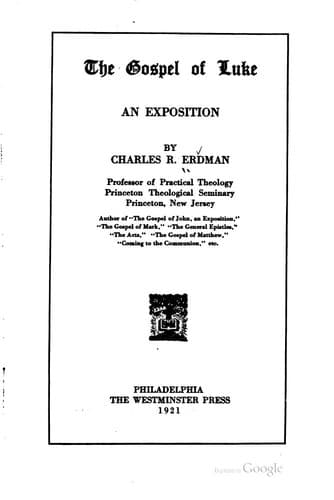
The Gospel of Luke, an expositionErdman, Charles Rosenbury
Religion
The Gospel of Luke, an exposition
Erdman, Charles Rosenbury
Bible. Luke -- Commentaries
It was not addressed to Pharisees, although it is a severe exposure of the
hypocrisy and self-deception of Pharisaism of every kind. Jesus seems
rather to have had in mind some of his own followers; but whatever their
class or profession, Pharisees have their representatives in every age and
land. They are described as “certain who trusted in themselves that they
were righteous, and set all others at nought.”
Such, indeed, was the Pharisee here described. He had gone up to the
Temple to pray; he stood in some conspicuous place; he addressed God but
he uttered no true prayer. He began by saying, “I thank thee,” but he
really addressed himself. He rejoiced that in comparison with other men he
formed a class by himself. He declared all others to be “extortioners,
unjust, adulterers,” and as an example of such sinners he pointed to the
poor publican at whom he was looking instead of looking to God. He boasted
that he had refrained from the sins of other men and also that he had
performed more good deeds than the law required. Moses instituted no
obligatory fast; but the Pharisee fasted twice in the week. Moses exempted
certain things from the tithe; the Pharisee had tithed his entire income.
In other words, he had been better than God required. He had placed God
under obligation to him. How little does such a man understand the real
holiness of God, of the requirements of that law the essence of which is
love!
In striking contrast the publican was standing at a respectful distance
from the supposed saint whose formal piety had impressed his fellow men.
He did not venture even to look toward heaven. He beat upon his breast, as
a sign of mourning, and cried out in anguish, “God, be thou merciful to me
a sinner.” The original words seem to imply that he regarded himself as
likewise distinct from all other men. He felt and confessed himself to be
“the sinner;” but as he acknowledged his guilt and turned to God in
penitence, he was accepted as righteous in the sight of God and received
pardon and peace.
There can be no misunderstanding as to the lesson which the Master wished
to impress. “This man went down to his house justified rather than the
other.” A sense of guilt and a yearning for pardon and a cry to God for
mercy—this is the very beginning of a new life; and however far one may
progress in holiness there is ever need of similar humility. The nearer
one is to God, the more conscious is he of his sinfulness and the less
likely to boast of his own moral attainments. The more one acknowledges
his unworthiness, the better is he prepared to serve his Master and his
fellow men. The pride of Pharisaism on the part of nations, as well as in
the lives of individuals, stands in the way of helpfulness and brotherhood
and the favor of God. What is needed to-day is universal repentance, a
manifestation of the humble and the contrite heart; “For every one that
exalteth himself shall be humbled; but he that humbleth himself shall be
exalted.”
Public-domain text, read in full here on John Shaqi.
Reviews
Reviews
No reviews yet
Be the first to share your thoughts on this work.
Elsewhere in the archive
Join the Discussion
Join the discussion
Sign in to leave a comment or review.
Sign InorCreate an account