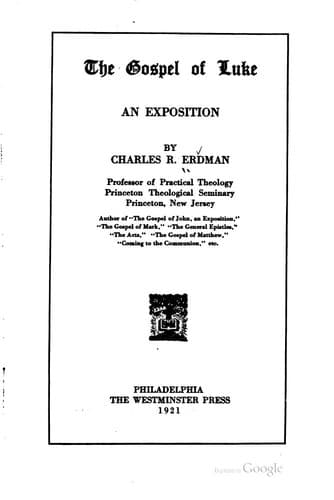
The Gospel of Luke, an expositionErdman, Charles Rosenbury
Religion
The Gospel of Luke, an exposition
Erdman, Charles Rosenbury
Bible. Luke -- Commentaries
As the crowds gazed in wonder and sympathy on this tender scene, our Lord
added this word of warning, “Whosoever shall not receive the kingdom of
God as a little child, he shall in no wise enter therein.”
6. The Rich Ruler. Ch. 18:18-30
18 And a certain ruler asked him, saying, Good Teacher, what shall
I do to inherit eternal life? 19 And Jesus said unto him, Why
callest thou me good? none is good, save one, _even_ God. 20 Thou
knowest the commandments, Do not commit adultery, Do not kill, Do
not steal, Do not bear false witness, Honor thy father and mother.
21 And he said, All these things have I observed from my youth up.
22 And when Jesus heard it, he said unto him, One thing thou
lackest yet: sell all that thou hast, and distribute unto the
poor, and thou shalt have treasure in heaven: and come, follow me.
23 But when he heard these things, he became exceedingly
sorrowful; for he was very rich. 24 And Jesus seeing him said, How
hardly shall they that have riches enter into the kingdom of God!
25 For it is easier for a camel to enter in through a needle’s
eye, than for a rich man to enter into the kingdom of God. 26 And
they that heard it said, Then who can be saved? 27 But he said,
The things which are impossible with men are possible with God. 28
And Peter said, Lo, we have left our own, and followed thee. 29
And he said unto them, Verily I say unto you, There is no man that
hath left house, or wife, or brethren or parents, or children, for
the kingdom of God’s sake, 30 who shall not receive manifold more
in this time, and in the world to come eternal life.
In contrast with the penitent publican and with the loving trust of little
children which Luke has been depicting, there steps upon the scene a young
man, rich, upright, morally earnest, but apparently unconscious of the
sinful greed which threatened his soul and of that trust in riches which
might prevent his entering the Kingdom of God. In spite of his riches, his
youth, his position, and his power, his heart was not satisfied. He had
come to Jesus with the question, “Good Teacher, what shall I do to inherit
eternal life?” Jesus at once rebuked him, “Why callest thou me good? none
is good, save one, even God.” By this reproof Jesus was neither defending
his own divinity nor denying his sinlessness. He wished to convince the
young man of his moral need. He intimated that the thoughtless use of the
word “good,” addressed to one whom he regarded as a human teacher, was a
proof that the young man had a superficial view of goodness. Judged by a
divine standard the young inquirer could not claim to be good, nor can any
man regard himself as righteous in the light of divine holiness.
Public-domain text, read in full here on John Shaqi.
Reviews
Reviews
No reviews yet
Be the first to share your thoughts on this work.
Elsewhere in the archive
Join the Discussion
Join the discussion
Sign in to leave a comment or review.
Sign InorCreate an account