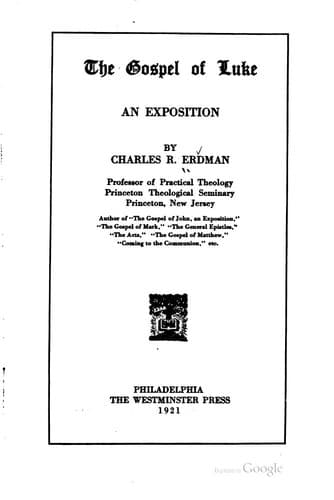
The Gospel of Luke, an expositionErdman, Charles Rosenbury
Religion
The Gospel of Luke, an exposition
Erdman, Charles Rosenbury
Bible. Luke -- Commentaries
In order to awaken the conscience and to disturb the complacent
self-righteousness of the young inquirer, Jesus now tested him in the
light of the commandments in which God has revealed his holy will. The
youth at once replied, “All these things have I observed from my youth
up.” Jesus now applied the deep probe which showed that the man had never
observed the spirit of the Law, even though he believed that he had kept
the letter. Jesus disclosed the real selfishness of the heart as he
proposed a supreme test: “One thing thou lackest yet: sell all that thou
hast, and distribute unto the poor, and thou shalt have treasure in
heaven: and come, follow me.” In this sentence Jesus convicted the man of
having broken the Law, the essential requirement of which was to love his
neighbor as himself.
Jesus promised an eternal recompense for sacrifice, and he offers by his
personal companionship the influence and power which will make the keeping
of the Law more possible and complete. No one can claim to be righteous
when judged by the commandments as interpreted by Christ. Our only hope is
to come to him for guidance and help. He will lay bare the secret
selfishness of our hearts, and will develop the spirit of love and service
which forms the essence of eternal life, and in heaven he will ultimately
recompense his followers for every loss.
Jesus does not demand that all who obey him must literally leave their
worldly possessions. In his command to the rich ruler he was dealing with
a specific case. He does demand, however, that each one shall give up
anything which prevents open, honest discipleship and fellowship with
himself. In the case of this inquirer the obstacle was his wealth. It was
impossible for him to retain it and yet to follow Christ. The Master made
plain to him that his goodness had been superficial and inadequate. He
showed him that love of money was the canker which had been hidden in his
soul. He plainly placed before him the necessity of choosing between his
wealth and the eternal life which Jesus alone can give. No wonder that
when the young ruler heard the stern requirements and realized for the
first time that he was controlled by his wealth, “He became exceeding
sorrowful; for he was very rich.” He kept his wealth and he rejected his
Saviour. He saw the possibility of eternal life, but he was not willing to
pay the price. He retained his riches, but he lost his soul.
Public-domain text, read in full here on John Shaqi.
Reviews
Reviews
No reviews yet
Be the first to share your thoughts on this work.
Elsewhere in the archive
Join the Discussion
Join the discussion
Sign in to leave a comment or review.
Sign InorCreate an account