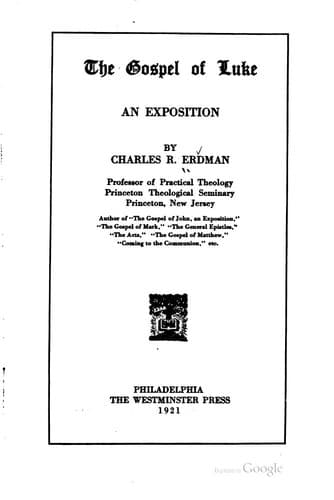
The Gospel of Luke, an expositionErdman, Charles Rosenbury
Religion
The Gospel of Luke, an exposition
Erdman, Charles Rosenbury
Bible. Luke -- Commentaries
As Jesus moved southward through Perea, nearing the end of his last
journey to Jerusalem, he was accompanied by admiring multitudes, but his
own heart was heavy with the knowledge of the suffering that awaited him
and he clearly saw before him the outline of the cross. Many of his
followers to-day share his experience in part; even in surroundings which
all observers envy, their hearts are crushed by secret sorrows and by the
knowledge of approaching pain.
Those who then were nearest to him were quite unconscious of his thoughts
or his need of sympathy. Then for the third time Jesus clearly predicted
his approaching death. He declared that his sufferings were to be in
accordance with written prophecy and now more clearly than ever he
described the details of all the anguish he must endure. He was to be
“delivered up unto the Gentiles” and therefore to be crucified, and with
all the sickening accompaniments of mockery and spitting and scourging, he
was to be killed.
Such a clear vision of what awaited him enhances for us the revelation of
his matchless heroism as he moved forward with unfaltering tread, giving
an inspiring example to each one who may be asked to take up the cross and
come after him.
Such knowledge reveals one who consciously was more than man, such a
confidence that he was fulfilling the prophecies of the inspired
Scriptures shows that he regarded himself as the Saviour of the world.
Such a willingness to suffer demonstrates the fact that he believed his
atoning death to be an essential part of his redeeming work.
The grave, however, was by no means his goal. With absolute definiteness
he declared that on the third day he would rise again. This vision of
triumph was in part the explanation of his courage. It was in virtue of
such a resurrection victory that he could be the Saviour of mankind.
His disciples, however, understood none of these things; with threefold
emphasis Luke describes their dullness of apprehension. They did not
believe that his death was necessary and for them the resurrection was not
even a dream. Their lack of expectation only made them more credible
witnesses of that resurrection when it did occur. However, would not a
clearer vision, unclouded by false notions of their own, have enabled them
to understand their Master and to bring some cheer to his lonely soul; and
does he not always desire his followers to accept his predictions with
implicit faith and to rest upon his promises with triumphant hope?
8. The Blind Man at Jericho. Ch. 18:35-43
Public-domain text, read in full here on John Shaqi.
Reviews
Reviews
No reviews yet
Be the first to share your thoughts on this work.
Elsewhere in the archive
Join the Discussion
Join the discussion
Sign in to leave a comment or review.
Sign InorCreate an account