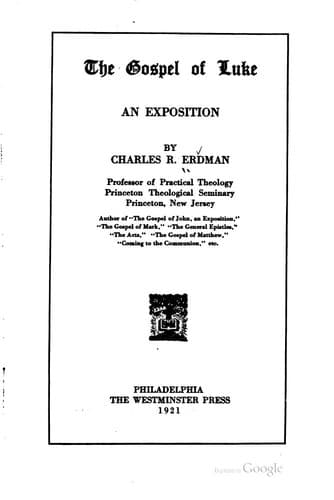
The Gospel of Luke, an expositionErdman, Charles Rosenbury
Religion
The Gospel of Luke, an exposition
Erdman, Charles Rosenbury
Bible. Luke -- Commentaries
As Jesus looked upon him in pity, he startled his disciples by the
statement of a truth which the scene had illustrated: “How hardly shall
they that have riches enter into the kingdom of God!” This was
particularly surprising to the Jews. They imagined that wealth was a
positive proof of divine favor. What then did Jesus mean? He did not
intend to teach that wealth is sinful or that private property is a social
wrong. He meant that riches may possibly keep their possessor from
Christian discipleship and that one who seeks to satisfy himself with such
wealth as keeps him from Christ can never enter the Kingdom of God. Jesus
even added a pardonable hyperbole, “It is easier for a camel to enter in
through a needle’s eye, than for a rich man to enter into the kingdom of
God.” One who would enter that Kingdom must become as a little child; he
must abandon all trust in self, and be willing to sacrifice anything which
prevents his becoming an obedient servant of Christ. When the disciples
heard this, they were astonished and asked, “Then who can be saved?” Our
Lord replied, “The things which are impossible with men are possible with
God.” It does require resolution and decision and sacrifice, but God is
ready to supply all needed grace. His spirit can strengthen those who turn
to him in their conscious need and with a real desire for a higher life.
As the rich man moved away sorrowfully in his costly robes, Peter looked
upon him with apparent scorn, and turned to Jesus with the self-complacent
remark, “Lo, we have left our own, and followed thee.” The reply of Jesus
was not intended to encourage men to follow him in hope of gain. His
salvation is a matter of grace. We are not to think that by any sacrifice
of worldly goods we can purchase eternal life. However, the tender words
of the Master do remind us that a rich recompense will be received for all
that we may surrender in becoming his disciples. Even in this present time
one receives a hundredfold reward, not in literal kind but in experiences
which now satisfy the soul and “in the world to come eternal life.”
7. Jesus Again Foretelling His Death. Ch. 18:31-34
31 And he took unto him the twelve, and said unto them, Behold, we
go up to Jerusalem, and all the things that are written through
the prophets shall be accomplished unto the Son of man. 32 For he
shall be delivered up unto the Gentiles, and shall be mocked, and
shamefully treated, and spit upon: 33 and they shall scourge and
kill him: and the third day he shall rise again. 34 And they
understood none of these things; and this saying was hid from
them, and they perceived not the things that were said.
Public-domain text, read in full here on John Shaqi.
Reviews
Reviews
No reviews yet
Be the first to share your thoughts on this work.
Elsewhere in the archive
Join the Discussion
Join the discussion
Sign in to leave a comment or review.
Sign InorCreate an account