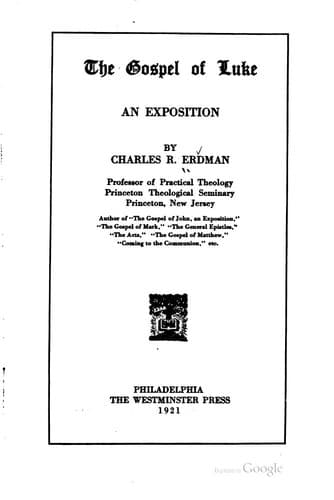
The Gospel of Luke, an expositionErdman, Charles Rosenbury
Religion
The Gospel of Luke, an exposition
Erdman, Charles Rosenbury
Bible. Luke -- Commentaries
This parable of the Pounds should be studied in connection with the
parables of the Unprofitable Servant, ch. 17:7-10, the Laborers in the
Vineyard, Matt. 20:1-16, and the Talents, Matt. 25:14-30. The first
teaches that no reward can be claimed as a matter of merit; in view of all
that the Master has given us, even pouring out his life for our
redemption, we never by the most faithful service could begin to pay the
debt we owe; even the most loyal devotion would be no ground for claiming
a reward.
The parable of the Laborers in the Vineyard likewise warns us against a
mercenary spirit in which we might serve the Master for the sake of a
reward, bargaining for so much labor for so much pay, jealous of those who
may receive as much as ourselves, though deserving, as we believe, less.
However, while no reward may be deserved, and while the hope of reward
should not be the motive for service, the Master has assured us that, in
absolute grace and with perfect justice, rewards will be granted to those
who are found faithful when he returns. The parable of the Talents teaches
that while opportunities and abilities for the service of Christ may
differ, those who are equally faithful will receive equal rewards. The
parable of the Pounds tells us that when opportunities are the same,
greater faithfulness will receive greater reward.
This latter parable was delivered, as Luke tells us, because Jesus “was
nigh to Jerusalem, and because they supposed that the kingdom of God was
immediately to appear.” Jesus therefore compared himself with a nobleman
who went into a far country, “to receive for himself a kingdom, and to
return.” Jesus was always indicating the fact that there would be a long
delay after his ascension before he would return, and that meanwhile his
followers should be faithful to the opportunities granted them for serving
their Master. In this parable Jesus pictured these opportunities under the
figure of pounds, that is, sums of money amounting to something like
sixteen dollars each. In comparison with a “talent” this was an
insignificant sum. Our Lord wished to suggest that to every one of his
followers something is intrusted which may be used for the advancement of
his cause.
Public-domain text, read in full here on John Shaqi.
Reviews
Reviews
No reviews yet
Be the first to share your thoughts on this work.
Elsewhere in the archive
Join the Discussion
Join the discussion
Sign in to leave a comment or review.
Sign InorCreate an account