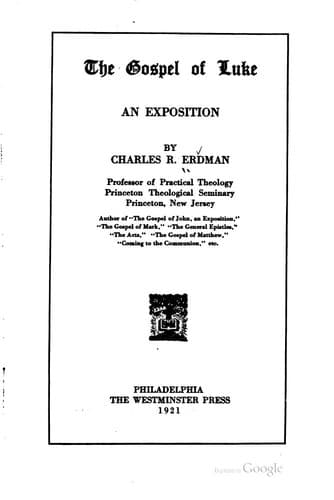
The Gospel of Luke, an expositionErdman, Charles Rosenbury
Religion
The Gospel of Luke, an exposition
Erdman, Charles Rosenbury
Bible. Luke -- Commentaries
Jesus knew that the Jews were not only to reject him but were to continue
in unbelief after his departure; thus in the parable he stated that “his
citizens hated him, and sent an ambassage after him, saying, We will not
that this man reign over us.” The main portion of the picture, however, is
concerned with the return of the nobleman and the reward of his servants.
This reward was proportioned to fidelity during the time of his absence.
By way of example, one who had so used his pound as to gain ten pounds was
made the ruler over ten cities; and one who had gained five, was appointed
over five cities. The reward for service is thus shown to be larger
service. Faithfulness in that which is very small is a preparation for
larger responsibilities and more glorious tasks. This is true in the
present, and the principle will be the same in the future.
One man was found, however, who had made no use of his pound. He had kept
it “laid up in a napkin.” His excuse was that he feared his master and he
said, almost boastfully, that he had not lost what had been intrusted to
him. He was giving back that which he had been given him. The nobleman,
however, properly rebuked this unfaithful servant in the very terms which
he himself had used. If the master was known to be so strict, the servant
should have been prepared to give a better account of his stewardship. It
is true that one cause for unfaithfulness is an ignorance of the true
nature of our Lord. Some are really afraid to undertake Christian service
because they do not know, what the parable could not indicate, namely,
that he who intrusts us with opportunities and abilities will give us
grace, if we seek to do our best and with a real desire to advance the
interests of our Lord, try to use the little which we have. Thus the
nobleman rebuked the unfaithful servant for not having done the least
which was possible. He could have placed the money in the bank and then if
nothing more, the master would have received the interest on the loan.
There is always something which every servant of Christ can do for him.
There is never any real excuse for idleness and inactivity and failure to
achieve something in the cause of Christ.
The pound was taken from the unfaithful servant and given to him who had
secured the ten pounds, because our Lord wished to illustrate the truth
that with our opportunities and privileges and gifts, the principle, use
or lose, always applies. The right employment of even small gifts results
in their enlargement, but failure to appreciate and employ that which we
possess results in its ultimate loss. “Unto every one that hath shall be
given; but from him that hath not, even that which he hath shall be taken
away from him.”
Public-domain text, read in full here on John Shaqi.
Reviews
Reviews
No reviews yet
Be the first to share your thoughts on this work.
Elsewhere in the archive
Join the Discussion
Join the discussion
Sign in to leave a comment or review.
Sign InorCreate an account