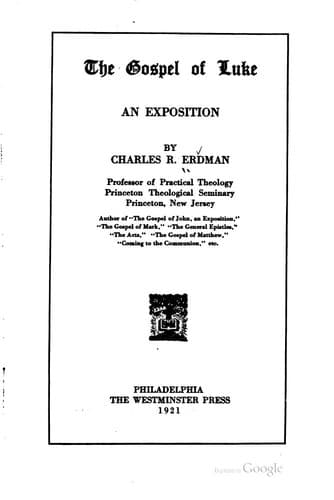
The Gospel of Luke, an expositionErdman, Charles Rosenbury
Religion
The Gospel of Luke, an exposition
Erdman, Charles Rosenbury
Bible. Luke -- Commentaries
The first stanza, or strophe, vs. 46-48, illustrates, as do those which
follow, one of the chief features of Hebrew poetry, namely, the
expression, in successive lines, of thoughts which are parallel or closely
related. In her “soul” or “spirit” or innermost being, Mary praises or
magnifies the Lord and rejoices in him as her Saviour. This salvation is
not only for her people, but particularly for herself; it is not only
political but also spiritual. It is to be wrought out by the gift God is
granting to Mary. He has chosen her, an obscure village maiden betrothed
to a poor carpenter, and has bestowed upon her such honor that all future
generations will call her “blessed.” While realizing the honor she dwells
most upon her unworthiness while recognizing what it may cost her, she
declares her submission as a true “bondmaid” or slave of the Lord.
Humility and faith could hardly be more sublime.
The second stanza, vs. 49, 50, centers the thought upon the character of
God as revealed in his gracious gift. His power, his holiness, his mercy
are praised. In his goodness to Mary he had shown his divine power, yet in
accordance with the moral perfection of his revealed nature and in order
to bring blessings to countless generations who would trust and reverence
him.
In the third stanza, vs. 51-53, is an illustration of another feature of
Hebrew poetry; not only is there striking parallelism, but here past
tenses are used to describe future events; the results of the coming of
the Messiah are stated as though already achieved. In contrast with the
blessedness of those that fear the Lord, “the proud,” the rebellious, and
unbelieving are pictured as “scattered” like the hosts of a defeated army;
the oppressed are exalted while tyrants are dethroned; the hungry are
filled and the rich are sent away “empty.” These results are to be
regarded as spiritual as well as physical. Such reversals are certain to
occur where Christ is accepted and those who receive blessings from him
are the humble who are conscious of their need.
The last strophe, vs. 54, 55, emphasizes the faithfulness of God to his
ancient promises which Mary sees fulfilled in the birth of her Son. In
this saving help given to Israel, God is showing that he has not forgotten
the mercy “toward Abraham and his seed” promised to the “fathers” of old.
Only in Christ Jesus can be realized all the promises to Israel, all the
hopes of the ages.
D. The Birth of John, and the “Benedictus.” Ch. 1:57-80
Public-domain text, read in full here on John Shaqi.
Reviews
Reviews
No reviews yet
Be the first to share your thoughts on this work.
Join the Discussion
Join the discussion
Sign in to leave a comment or review.
Sign InorCreate an account