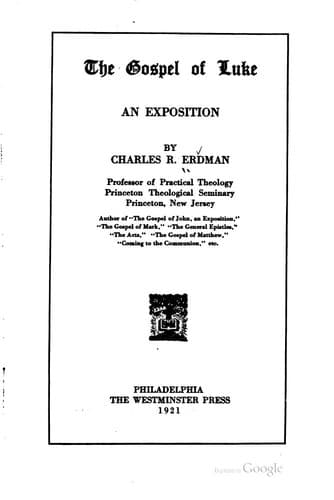
The Gospel of Luke, an expositionErdman, Charles Rosenbury
Religion
The Gospel of Luke, an exposition
Erdman, Charles Rosenbury
Bible. Luke -- Commentaries
To the malicious challenge of his enemies Jesus had already replied,
claiming for himself divine authority and condemning the rulers for their
guilty unbelief. He now added a parable, more clearly stating his claims
and more solemnly rebuking these hostile rulers and pronouncing judgment
upon the nation they represented. He told the story of a householder who
established and equipped a vineyard and let it out to tenants. He lived at
a distance and expected as rent a certain portion of the vintage. When he
sent for the fruit, however, his messengers were abused and killed; at
last his own son was sent and was slain. He determined to come and to
exact justice and to deliver his vineyard to tenants who were more worthy.
The parable was so plain that the enemies of Jesus perfectly understood
its meaning. The householder was his Father; the vineyard was Israel; the
husbandmen were the rulers to whom the nation had been intrusted; the
servants were the prophets sent to summon the people to repent and to
render to God the fruits of righteousness; the son was Jesus himself, who
thus claimed a unique relation to God, distinct from the prophets and from
all human messengers; the death of the heir was his own approaching
crucifixion; the return of the householder was the coming visitation of
divine judgment, the rejection of Israel, and the call of the Gentiles. It
was aside from the present purpose of Jesus to refer to the individual
Jews who would accept him and to the future conversion of the nation of
which Paul wrote. He wished now to emphasize his own rejection and the
guilt and punishment of the nation. He declared, however, that this death
would issue in his exaltation and triumph; that he was “the stone which
the builders rejected,” which “was made the head of the corner.” He also
warned his enemies that all who, in unbelief, should stumble on that
stone, all who should reject him, would be “broken to pieces,” and all who
should attempt to drag down that stone would be ground and scattered as
dust.
D. The Question As To Paying Tribute. Ch. 20:19-26
Public-domain text, read in full here on John Shaqi.
Reviews
Reviews
No reviews yet
Be the first to share your thoughts on this work.
Elsewhere in the archive
Join the Discussion
Join the discussion
Sign in to leave a comment or review.
Sign InorCreate an account