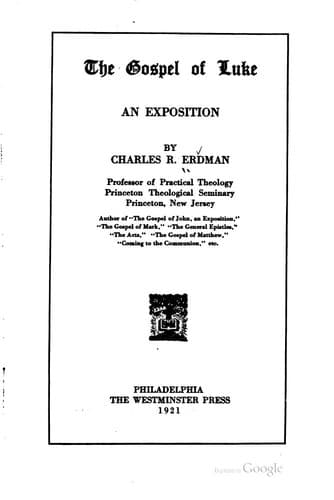
The Gospel of Luke, an expositionErdman, Charles Rosenbury
Religion
The Gospel of Luke, an exposition
Erdman, Charles Rosenbury
Bible. Luke -- Commentaries
19 And the scribes and the chief priests sought to lay hands on
him in that very hour; and they feared the people: for they
perceived that he spake this parable against them. 20 And they
watched him, and sent forth spies, who feigned themselves to be
righteous, that they might take hold of his speech, so as to
deliver him up to the rule and to the authority of the governor.
21 And they asked him, saying, Teacher, we know that thou sayest
and teachest rightly, and acceptest not the person _of any_, but
of a truth teachest the way of God: 22 Is it lawful for us to give
tribute unto Cæsar, or not? 23 But he perceived their craftiness,
and said unto them, 24 Show me a denarius. Whose image and
superscription hath it? And they said, Cæsar’s. 25 And he said
unto them, Then render unto Cæsar the things that are Cæsar’s, and
unto God the things that are God’s. 26 And they were not able to
take hold of the saying before the people: and they marvelled at
his answer, and held their peace.
The rulers had been defeated, discredited, and disgraced but they had not
been discouraged. In their first question they failed utterly to bring
Jesus into any unlawful opposition to the religious courts. They now
attempted by a new question to draw from him an answer which either would
make him unpopular with the people or would bring him under the
condemnation of the civil ruler. They asked him a question relative to the
payment of tribute to the Roman Government. The more conservative Jews
held that God was the ruler of Israel and that possibly it was wrong to
pay taxes to support a heathen state. The more liberal party sided with
the Herods, who owed their power to Rome. Therefore the enemies of Jesus
sent to him representatives of both parties, Pharisees and Herodians, so
that if he should avoid offending one party he would displease the other.
They approached Jesus with the flattering assurance that he was so
truthful and courageous that he would not hesitate to express his true
convictions; and then they proposed their artful question: “Is it lawful
for us to give tribute unto Cæsar, or not?” Should Jesus say, “Yes”? Then
he would cease to be a popular idol, for the people loathed the hateful
oppression of Rome. Should Jesus say, “No”? Then his enemies would hurry
him away to the Roman governor and the cross, as a traitor and a rebel.
The dilemma seemed complete; yet Jesus not only escaped the snare, but, in
his reply, he enunciated a law for all time. “Render unto Cæsar the things
that are Cæsar’s, and unto God the things that are God’s.”
Public-domain text, read in full here on John Shaqi.
Reviews
Reviews
No reviews yet
Be the first to share your thoughts on this work.
Elsewhere in the archive
Join the Discussion
Join the discussion
Sign in to leave a comment or review.
Sign InorCreate an account