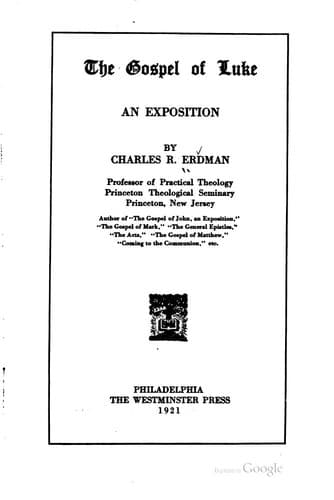
The Gospel of Luke, an expositionErdman, Charles Rosenbury
Religion
The Gospel of Luke, an exposition
Erdman, Charles Rosenbury
Bible. Luke -- Commentaries
Jesus had defeated his enemies in debate. They had come to him with a
series of crafty questions designed to discredit him as a public teacher
and to secure some ground for his arrest. To each of these questions he
had given a reply by which his foes had been unmasked and condemned. He
then asked them a question. It was intended not only forever to silence
his foes, though it accomplished this, for henceforth no man ventured to
meet him in public discussion; nor yet did Jesus desire further to
humiliate his enemies. In the presence of the people he had already shown
them to be ridiculous, contemptible, impotent, and insincere. His real
motive was to ask a question, the answer to which would embody the chief
of all his claims, namely, the claim that he is divine. It was of supreme
importance that this claim should be made at exactly this time. He knew
that the rulers had been unable to find a charge on which to arraign him
before either the ecclesiastical or the civil court. He realized that they
would dare to make no other attempt in public, but he clearly foresaw the
fact that, through the treachery of Judas, he would be arrested and,
before both these courts, would be arraigned on the charge of blasphemy.
His enemies would accuse him of claiming to be not only the Messiah but
also divine. On this occasion, therefore, in the presence both of the
rulers and the people, he made the defense which never can be broken or
forgotten as he definitely demonstrated from Scripture that the Messiah
was described by the inspired writers as a divine Being. All that Jesus
claimed for himself, as recorded in the Gospel of John, was included in
the answer which was implied by the question which he now asked. Even for
the present day it involves the supreme problem in the sphere of
philosophy and religion. This problem concerns the person of Christ. Is he
to be regarded as Man or God, or at once God and Man? Where is he to be
placed in the scale of being; or, as Jesus voiced the problem, how could
David speak of the coming Messiah as both his son and his Lord? There was
but one answer. There can be but one. The Messiah was to be divine. The
son of David is also the Son of God. The incarnation is the only solution
of our most serious difficulties in the realm of religious belief. By his
question Jesus not only silenced his enemies; he also showed their
insincerity in condemning him to death and their rejection of the inspired
Scriptures in their unwillingness to believe the testimony concerning the
person of the Messiah. Jesus unquestionably claimed to be the divine
Saviour of the world. The ideal Man is also the incarnate God.
G. The Warning Against The Scribes. Ch. 20:45-47
Public-domain text, read in full here on John Shaqi.
Reviews
Reviews
No reviews yet
Be the first to share your thoughts on this work.
Elsewhere in the archive
Join the Discussion
Join the discussion
Sign in to leave a comment or review.
Sign InorCreate an account