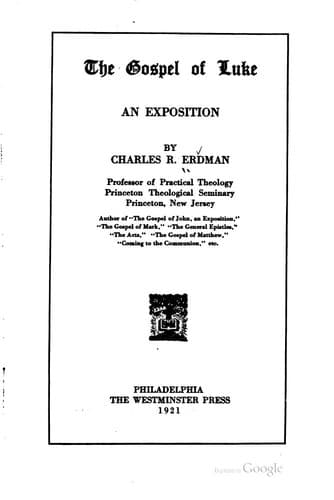
The Gospel of Luke, an expositionErdman, Charles Rosenbury
Religion
The Gospel of Luke, an exposition
Erdman, Charles Rosenbury
Bible. Luke -- Commentaries
45 And in the hearing of all the people he said unto his
disciples, 46 Beware of the scribes, who desire to walk in long
robes, and love salutations in the marketplaces, and chief seats
in the synagogues, and chief places at feasts; 47 who devour
widows’ houses, and for a pretence make long prayers: these shall
receive greater condemnation.
As the long day of public controversy drew to its close, it was not
strange that Jesus turned to warn the people against these enemies who had
been seeking to defeat him and who were determined upon his death. These
professed guides could not be followed safely. These rulers had shown
themselves to be unworthy of their place and power. The people must look
elsewhere for true teachers. They must find other men to interpret for
them the will of God.
The scribes were the professional teachers of the day, the trained
expositors of the Law. Most of them were Pharisees. They were of all men
the most bitter enemies of Christ; they were jealous of his power; they
were angered at his claims; and finally they had been goaded to
desperation by their humiliating defeat at his hands. Upon these men Jesus
pronounced the most stern condemnation. His words are recorded at length
by Matthew. In the brief summary of the discourse made by Mark and by Luke
we find only a few short sentences which sketch three principal features
in the character of these unworthy leaders of religious thought. The first
is their vanity, their ambition for display and for high position, and
their love of flattery. The second is their cruel avarice, expressed by
our Lord in the suggestive clause, “who devour widows’ houses.” The third
was their shameful hypocrisy; they are described as men who “for a
pretence make long prayers.” It has always been remarked that the most
bitter denunciations of Jesus were addressed to the men whose outward
lives were most respectable and whose religious professions were most
loud. This does not mean, however, that open vice and flagrant sin are
better than selfish and proud morality; but it does remind us that great
religious privileges and the possession of revealed truth involve solemn
responsibilities and that hypocrisy and pretense are abominations in the
sight of God.
H. The Widow’s Mites. Ch. 21:1-4
1 And he looked up, and saw the rich men that were casting their
gifts into the treasury. 2 And he saw a certain poor widow casting
in thither two mites. 3 And he said, Of a truth I say unto you,
This poor widow cast in more than they all: 4 for all these did of
their superfluity cast in unto the gifts; but she of her want did
cast in all the living that she had.
Public-domain text, read in full here on John Shaqi.
Reviews
Reviews
No reviews yet
Be the first to share your thoughts on this work.
Elsewhere in the archive
Join the Discussion
Join the discussion
Sign in to leave a comment or review.
Sign InorCreate an account