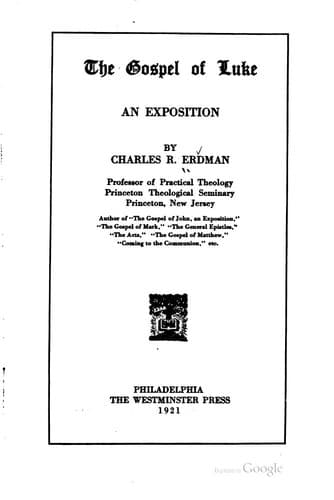
The Gospel of Luke, an expositionErdman, Charles Rosenbury
Religion
The Gospel of Luke, an exposition
Erdman, Charles Rosenbury
Bible. Luke -- Commentaries
What a contrast this charming sketch supplies to the picture which Jesus
drew of the Pharisees! In the eyes of the world the service of the poor
widow was meager and worthless, while the gifts of the hypocrites were
costly and great; in the eyes of the Lord their offerings were
comparatively worthless and she gave more than they all. As a matter of
fact, she had brought but two small coins, worth less than a half cent,
but they were all that she had. With this scene in mind we should be
careful not to call our offerings “mites” unless they are all that we
possess; we should be encouraged, however, to know that our Lord looks
upon the heart and estimates the gift by the motive and the love and the
sacrifice involved; above all, we should be reminded that we can best
measure our offerings not by what we give but by how much we keep. The
influence of the woman is still moving multitudes toward the treasury of
the Lord.
I. The Destruction Of Jerusalem And The Coming Of Christ. Ch. 21:5-38
During the days of his ministry Jesus frequently predicted his death and
also his return to glory. He saw clearly before him a cross but on the
distant horizon a throne. Again and again he had warned the Jews that
their rejection of him and of his call to repentance would result in the
destruction of Jerusalem and in the anguish of their race, and quite as
frequently he had told his disciples that while indeed he was to die and
rise again, a long period of time would pass before he would return in
glory to establish his Kingdom. The great, final discourse relating to the
future was delivered at the close of his last day of public controversy
and teaching. As Jesus sat with his disciples on the slope of the Mount of
Olives, as he looked westward and saw the sun sinking behind the majestic
buildings of the sacred city, he realized that in truth the night was
gathering over the nation, that his own day of earthly ministry was done,
and that the true dawning would not break for the world until the Son of
righteousness should arise in true glory, until he himself would return to
fill the earth with the peace and joy and splendor of his universal reign.
He, therefore, told his disciples with much detail the story of the
approaching destruction of Jerusalem and of his own return after the long
years of faithful service and of eager waiting which were appointed for
his followers.
Public-domain text, read in full here on John Shaqi.
Reviews
Reviews
No reviews yet
Be the first to share your thoughts on this work.
Elsewhere in the archive
Join the Discussion
Join the discussion
Sign in to leave a comment or review.
Sign InorCreate an account