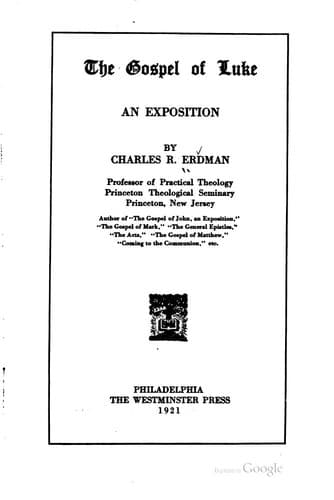
The Gospel of Luke, an expositionErdman, Charles Rosenbury
Religion
The Gospel of Luke, an exposition
Erdman, Charles Rosenbury
Bible. Luke -- Commentaries
When the aged priest, Zacharias, had received from an angel the promise
that he was to be given a son who would be called John and who would be
the herald of Christ, and when he had asked for a sign to attest the truth
of the prediction, he was smitten with dumbness as a rebuke for his
unbelief and as a stimulus for his faith. Even when at last the promise
was fulfilled, the sign was not removed and he was not able to speak until
he had given a written expression of his confidence in God. This
interesting incident occurred on the eighth day after the birth of John,
when in the presence of their rejoicing friends the parents were about to
name the child. Many supposed that the name of the father would be
selected. The mother, however, intimated that the name might be “John.”
When Zacharias, the father, was consulted, “he asked for a writing tablet,
and wrote, ... His name is John.” There was no hesitation, no uncertainty,
no question in his mind, for this name had been predicted by the angel,
and Zacharias showed by his decision and firmness that he believed
absolutely in the fulfillment of all that the angel had promised
concerning the career of the son who was to be regarded by his fellow men
as a gift of divine grace and a prophet of divine appointment. It usually
happens that a public confession of faith results in new joy and in wider
testimony. It was surely so in the case of Zacharias: “His mouth was
opened immediately, ... and he spake, blessing God.” His thanksgiving was
voiced in a hymn which, for hundreds of years, has been sung daily in
Christian worship. It is indeed a Christian hymn and a hymn of the
nativity; for while its occasion was the birth of John, only one stanza
refers to that event; the whole burden of the thanksgiving refers to the
approaching birth of Jesus and to the salvation which he is to bring.
This hymn is named the Benedictus from the first word in the Latin
version. It is an ecstatic expression of gratitude to God for his
boundless goodness. The poem possibly may be divided into five stanzas of
four lines each; but there is a definite pause after the third of these
stanzas when the thought turns from the work of Christ to the specific
mission of John.
The first strophe, vs. 68, 69, speaks of the redemption of Israel as
already accomplished in the gift of the Christ who is about to be born and
who is described as “a horn of salvation,” that is, a manifestation of
saving power. He is to appear as a son and heir of David the king.
The second stanza, or strophe, vs. 70-72, indicates that the salvation
from all enemies is in fulfillment of the promises made through the
prophets and cherished by the ancient fathers and embodied in the holy
covenant made with Israel of old.
Public-domain text, read in full here on John Shaqi.
Reviews
Reviews
No reviews yet
Be the first to share your thoughts on this work.
Join the Discussion
Join the discussion
Sign in to leave a comment or review.
Sign InorCreate an account