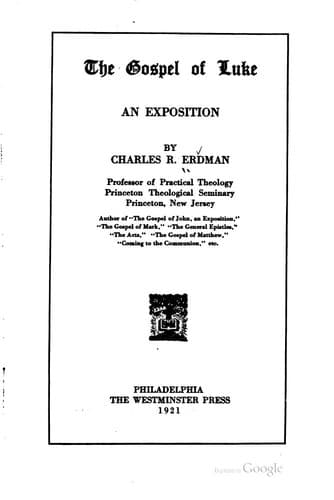
The Gospel of Luke, an expositionErdman, Charles Rosenbury
Religion
The Gospel of Luke, an exposition
Erdman, Charles Rosenbury
Bible. Luke -- Commentaries
39 And he came out, and went, as his custom was, unto the mount of
Olives; and the disciples also followed him. 40 And when he was at
the place, he said unto them, Pray that ye enter not into
temptation. 41 And he was parted from them about a stone’s cast;
and he kneeled down and prayed, 42 saying, Father, if thou be
willing, remove this cup from me: nevertheless not my will, but
thine, be done. 43 And there appeared unto him an angel from
heaven, strengthening him. 44 And being in an agony he prayed more
earnestly; and his sweat became as it were great drops of blood
falling down upon the ground. 45 And when he rose up from his
prayer, he came unto the disciples, and found them sleeping for
sorrow, 46 and said unto them, Why sleep ye? rise and pray, that
ye enter not into temptation.
From the quiet fellowship in the upper room Jesus with his disciples,
under the shadow of the night, went forth to the Garden of Gethsemane, a
favorite resort on the slope of the Mount of Olives, and he there
experienced that unequaled anguish of soul which is commonly known as his
“agony.” To enter the sacred privacy of that scene even in imagination
seems to be an intrusion, and yet some glimpses have been revealed for our
instruction and encouragement as his disciples.
There can be no doubt that this distress which seized him was due to his
clear vision of the death he was to endure on the following day; and this
very agony adds beyond measure to the meaning and the mystery of that
death. For any sensitive soul to shrink from pain and anguish is but
natural and pardonable; yet if Jesus suffered such incomparable agony
simply in view of physical torture, he was less heroic than many of his
followers have been. If, however, in the hour of death, he was to be so
identified with sin as to become the Redeemer of the world; if he was “to
give his life a ransom for many;” if his experience as the Lamb of God was
to be absolutely unique; if he was to endure the hiding of his Father’s
face, then we can understand why it was that in the dark hour of
anticipation his soul was sorrowful “even unto death.” The agony of our
Lord must never be supposed to reflect upon his human heroism; it is
rather a proof of his divine atonement. The “cup” which Jesus was asked to
drink consisted of death as “the Bearer of sin.”
Public-domain text, read in full here on John Shaqi.
Reviews
Reviews
No reviews yet
Be the first to share your thoughts on this work.
Elsewhere in the archive
Join the Discussion
Join the discussion
Sign in to leave a comment or review.
Sign InorCreate an account