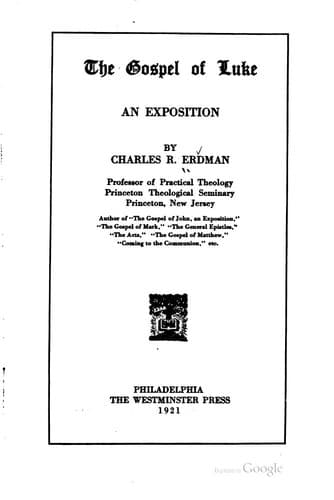
The Gospel of Luke, an expositionErdman, Charles Rosenbury
Religion
The Gospel of Luke, an exposition
Erdman, Charles Rosenbury
Bible. Luke -- Commentaries
13 And Pilate called together the chief priests and the rulers and
the people, 14 and said unto them, Ye brought unto me this man, as
one that perverteth the people: and behold, I, having examined him
before you, found no fault in this man touching those things
whereof ye accuse him: 15 no, nor yet Herod: for he sent him back
unto us; and behold, nothing worthy of death hath been done by
him. 16 I will therefore chastise him, and release him. 18 But
they cried out all together, saying, Away with this man, and
release unto us Barabbas—19 one who for a certain insurrection
made in the city, and for murder, was cast into prison. 20 And
Pilate spake unto them again, desiring to release Jesus; 21 but
they shouted, saying, Crucify, crucify him. 22 And he said unto
them the third time, Why, what evil hath this man done? I have
found no cause of death in him: I will therefore chastise him and
release him. 23 But they were urgent with loud voices, asking that
he might be crucified. And their voices prevailed. 24 And Pilate
gave sentence that what they asked for should be done. 25 And he
released him that for insurrection and murder had been cast into
prison, whom they asked for; but Jesus he delivered up to their
will.
The Jews had been deprived by their Roman conquerors of the right to
inflict capital punishment. When, therefore, their chief council had
decided that Jesus was worthy of death, the rulers brought him to Pilate,
the Roman governor, that he might confirm their sentence and execute the
cruel penalty of crucifixion. The trial before Pilate developed into a
disgraceful contest between the murderous and determined Jewish rulers and
the weak and vacillating Roman governor, who was at last compelled to act
contrary to his conscience and his desire and to submit his will to that
of the subjects whom he detested.
Luke gives only a bare outline of the story, which is sketched best by the
apostle John. Enough, however, is given to show the infamous baseness of
the Jews and the futile endeavors of Pilate to avoid the judicial murder
which he finally committed. The Jewish rulers had asked Pilate to
pronounce sentence without hearing the charge; this Pilate properly
refused to do. When the accusation was made, Luke shows most clearly how
craftily the decision of the Jewish court was perverted, and how forcibly
the false charge was presented. Jesus had been convicted of claiming to be
the divine Messiah. It was the claim of deity, and thus of blasphemy, on
which he was condemned. The Jews knew that this would make no impression
on Pilate. However, the office of Messiah did imply rule and authority,
and therefore the claim of Jesus was distorted into a political offense
and he was charged with sedition, with forbidding tribute to Cæsar, and
with claiming to be a king.
Public-domain text, read in full here on John Shaqi.
Reviews
Reviews
No reviews yet
Be the first to share your thoughts on this work.
Elsewhere in the archive
Join the Discussion
Join the discussion
Sign in to leave a comment or review.
Sign InorCreate an account