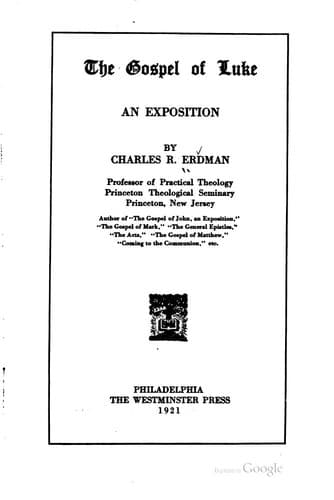
The Gospel of Luke, an expositionErdman, Charles Rosenbury
Religion
The Gospel of Luke, an exposition
Erdman, Charles Rosenbury
Bible. Luke -- Commentaries
How absurd all these accusations were, Pilate soon learned; he probably
was not a little suspicious of the sudden zeal for their Roman tyrants
shown by these rebellious Jews. However, he lacked the courage of his
convictions; he declared Jesus to be innocent, but fearing to offend the
rulers and the crowds whom they had won to their will, he hesitated to
release Jesus. That was a fatal step; the only thing to do is to act with
decision and promptness as soon as one sees what is right. It is surely
true in matters of conscience that “he who hesitates is lost.”
Then Pilate did what all weak men are apt to do: he attempted to avoid
making a decision; he tried to shift the responsibility; he learned that
Jesus was from Galilee, and so Pilate sent Jesus to be judged by King
Herod, within whose realm Galilee lay. Herod was then in Jerusalem, and he
was eager to see Jesus, of whom he had heard so much, and he hoped that
his curiosity might be gratified by seeing Jesus perform some miracle.
However, when appearing before Herod, Jesus refused even to answer him by
a single word. Jesus has a message for every penitent, and a miracle for
every believer; but for the murderer of John and for the shallow, sinful
profligate there is only silence and contempt.
To wreak upon Jesus a petty revenge, Herod mocked Jesus by clothing him
with royal apparel, and sent him back thus arrayed to Pilate. It was a
cruel jest, but it was an acquittal of Jesus as guilty of no political
offense. Thus Pilate was forced to act as judge; others cannot decide for
us questions of conscience. When compelled to act, Pilate attempted a
second maneuver familiar to all weak souls; he proposed to compromise. He
would do what was wrong but he would avoid the crime of murder. He offered
to scourge Jesus, whom he declared to be absolutely innocent, or to
release him as a notable criminal, as one such was usually released at
this feast. On the one hand, he would be subjecting Jesus to the most
agonizing bodily torture; on the other, he would brand Jesus as a
malefactor who had deserved death. Compromise in a case of conscience is
always a sign of weakness, and the enemy is sure to press his advantage.
As the rulers saw Pilate yielding thus far, they asked for the release of
a notorious murderer by the name of Barabbas; and as they saw Jesus coming
forth from the scourging, torn and bleeding, they cried out for his life,
“Crucify him, crucify him.” As Pilate hesitated, the rulers used their
most deadly weapon; they suggested that they would report Pilate to the
emperor as shielding a political revolutionist; they would imperil the
position and life of the governor. This attack Pilate could not withstand;
when some personal loss was involved conscience was no longer to be
considered. He decided to do what he knew to be wrong; he “gave sentence
that what they asked for should be done;” and so doing he placed himself
near the head of that long list of moral cowards who share his eternal
Public-domain text, read in full here on John Shaqi.
Reviews
Reviews
No reviews yet
Be the first to share your thoughts on this work.
Elsewhere in the archive
Join the Discussion
Join the discussion
Sign in to leave a comment or review.
Sign InorCreate an account