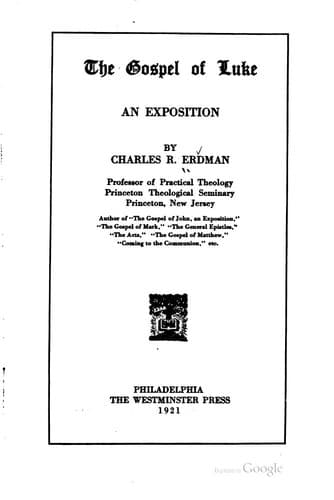
The Gospel of Luke, an expositionErdman, Charles Rosenbury
Religion
The Gospel of Luke, an exposition
Erdman, Charles Rosenbury
Bible. Luke -- Commentaries
The Gospel narratives spare us the distressing details of the crucifixion;
this was the most cruel and agonizing form of death; but the facts are
written with surprising delicacy and reserve. As Jesus was being led from
the city a certain Simon of Cyrene was pressed into the service of bearing
his cross. The cause of this action is purely a matter of conjecture. Its
result was to give Simon immortal fame and apparently to secure for him
eternal salvation; for it seems that this experience, and the knowledge of
Christ gained at Calvary, resulted in the conversion of Simon and his
household, Mark 15:21; Rom. 16:13. In a figure, he was the first of that
long line of men and women who have taken up the cross and followed
Christ. Of course this is a mere symbol, and the actual contrasts are
vital. In reality no one can share the burden of the cross which our
Saviour bore. His sufferings, and his alone, made atonement for sin. Then
again no one can be compelled to take up the cross. There are burdens in
life which cannot be evaded but one can refuse the cross. It is a type of
the voluntary suffering endured for the sake of Christ; it is a symbol of
the complete sacrifice of self and the complete submission to his will
which is necessary for all who share in the redeeming benefits of his
death.
Luke alone records the incident of the women who, wailing and lamenting,
followed Jesus out of the city. It is quite fitting that in this Gospel,
in which womanhood is so exalted, a place should be found for this
picture. It is not to be supposed that these were the loyal friends who
had followed Jesus on his journeys and helped to supply his needs; these
were rather residents of Jerusalem whose hearts were bleeding with sorrow
for the loving Prophet who was being led forth to an agonizing death. Our
Lord turned to these women with a message of sympathy and told them that
they were not to weep for him but for themselves and their children. He
was not rebuking them for their compassion; he rather meant to indicate
that while his sufferings were pitiful, their own were more worthy of
tears, for they were to be even more intense. He had in mind the
destruction of the city due to its impenitence and made certain by its
rejection of the Redeemer. Jesus declared that the days would come when
childlessness would be a ground for congratulation because of the
universal distress. He predicted that the horror would be so great that
men would call upon the mountains to fall on them and the hills to cover
them, preferring such forms of death to the torments which threatened from
the armies of Rome. Jesus added a proverb, the force of which is evident
even though its exact application may not be clear: “For if they do these
things in the green tree, what shall be done in the dry?” In other words,
if the sufferings of Christ were so great, what would be the sufferings of
the Jews! If the Romans were putting to death him whom they regarded as
Public-domain text, read in full here on John Shaqi.
Reviews
Reviews
No reviews yet
Be the first to share your thoughts on this work.
Elsewhere in the archive
Join the Discussion
Join the discussion
Sign in to leave a comment or review.
Sign InorCreate an account