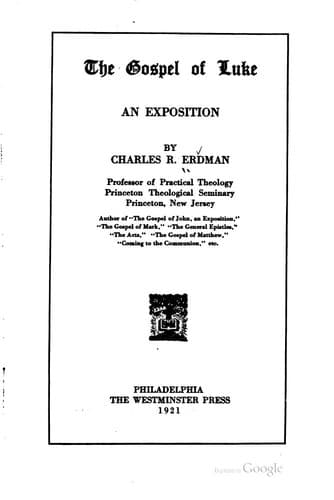
The Gospel of Luke, an expositionErdman, Charles Rosenbury
Religion
The Gospel of Luke, an exposition
Erdman, Charles Rosenbury
Bible. Luke -- Commentaries
innocent, what would they do to the inhabitants of the rebellious and
hated city? It is quite in accordance with the character of Luke to note
how Jesus, in this very hour of his anguish, thought rather of others than
of himself and pronounced this prophesy, not in resentment, but in
infinite tenderness and pity.
While the actual sufferings of the crucifixion are not described, Luke
tells us of the cruel mockery to which Jesus was subjected. He states that
two malefactors were crucified with Jesus, “one on the right hand and the
other on the left.” This was evidently designed to add to the disgrace and
humiliation of his cruel death. The place of the crucifixion was called
“The skull,” probably because it was a bare, rounded hill located outside
the city gates.
Of the seven words spoken by Jesus on the cross, Luke records three, all
of them characterized by love and trust. The first is found in no other
Gospel. As Jesus tasted the first bitterness of his anguish he was heard
to pray, “Father forgive them; for they know not what they do.” He did not
have in mind simply the soldiers who were involuntary instruments of his
death, but rather the Jews who had not fully recognized the enormity of
their crime. For them Jesus felt no hatred in his heart. He yearned for
their repentance and their salvation. This prayer was a revelation of the
matchless grace and mercy of this ideal Man. Luke adds the details of the
mockery to which the other evangelists likewise refer. The crowds stood
gazing upon the Sufferer but the rulers and the soldiers cruelly mocked
him; the former scoffed at him saying, “He saved others; let him save
himself.” In reality, had he saved himself, he never could have saved
others. He died for the very men who were deriding him, to make possible
their salvation. The soldiers made sport of him by casting lots for his
garments and by offering him drink and hailing him as “King of the Jews.”
This last title had been placed on the cross above the head of Jesus. It
was put there by Pilate in bitter irony. It was his way of taking revenge
upon the rulers who, contrary to his conscience, had compelled him to put
to death an innocent Man. In place of this superscription the eye of faith
sees another, “Behold, the Lamb of God, that taketh away the sin of the
world!”
I. The Penitent Thief. Ch. 23:39-43
39 And one of the malefactors that were hanged railed on him,
saying, Art not thou the Christ? save thyself and us. 40 But the
other answered, and rebuking him said, Dost thou not even fear
God, seeing thou art in the same condemnation? 41 And we indeed
justly; for we receive the due reward of our deeds: but this man
hath done nothing amiss. 42 And he said, Jesus, remember me when
thou comest in thy kingdom. 43 And he said unto him, Verily I say
unto thee, To-day shalt thou be with me in Paradise.
Public-domain text, read in full here on John Shaqi.
Reviews
Reviews
No reviews yet
Be the first to share your thoughts on this work.
Elsewhere in the archive
Join the Discussion
Join the discussion
Sign in to leave a comment or review.
Sign InorCreate an account