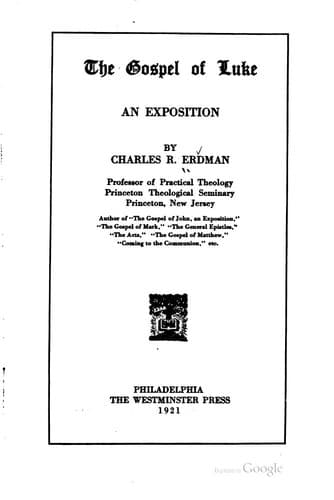
The Gospel of Luke, an expositionErdman, Charles Rosenbury
Religion
The Gospel of Luke, an exposition
Erdman, Charles Rosenbury
Bible. Luke -- Commentaries
This story which enshrines for us the second saying of our Lord upon the
cross has often been regarded as one of the most significant narratives in
the Gospels: first, because it gives us such a picture of the unique
person of Christ; here was a dying man who at the same time was a
forgiving God. Then, here is a picture of the transforming power of Christ
who in an instant of time changed a robber into a saint. Most of all, we
have here a message of the conditions of salvation which are ever the
same, namely, repentance and faith. The first of these conditions is
strikingly illustrated from the fact that the repentant thief was thinking
of God and remembering that it was against a divine Being that he had
sinned. Of this fact he reminded his companion, intimating that they might
properly fear him into whose august presence they were so soon to be
ushered. It is the very essence of repentance to regard sin, not as a
mistake or a weakness, or as an injury to men, but as rebellion and insult
against God. His penitence was further shown in his recognition that the
penalty which he was suffering was just, and in his recognition of the
innocent sufferings of Christ.
His faith was as remarkable as his repentance. He saw in the bleeding,
dying Sufferer, One who is yet to return as universal King, and to him he
addressed his prayer: “Jesus, remember me when thou comest in thy
kingdom.” We do not know the source of such faith. The robber may have
heard part of the trial of Jesus; he did hear him praying for his enemies;
but whatever gave rise to his belief and trust, he regarded Jesus as a
Saviour and Lord who was yet to reign and who could bring him to eternal
glory. This story thus reveals to us the truth that salvation is
conditioned upon repentance and faith. However, it contains other
important messages also. It declares that salvation is independent of
sacraments. The thief had never been baptized, nor had he partaken of the
Lord’s Supper. It is obvious that had he lived he would have carried out
the requirements of his Lord by accepting these sacraments. He did, in
fact, boldly confess his faith in the presence of a hostile crowd and amid
the taunts and jeers of rulers and soldiers, yet he was saved without any
formal rites.
It is further evident that salvation is independent of good works. The
thief was pardoned before he had lived a single, righteous, innocent day.
Of course, good works follow faith; they evidence its reality; but faith
precedes and results in holiness. A life of goodness is an expression of
gratitude for salvation already begun.
Public-domain text, read in full here on John Shaqi.
Reviews
Reviews
No reviews yet
Be the first to share your thoughts on this work.
Elsewhere in the archive
Join the Discussion
Join the discussion
Sign in to leave a comment or review.
Sign InorCreate an account