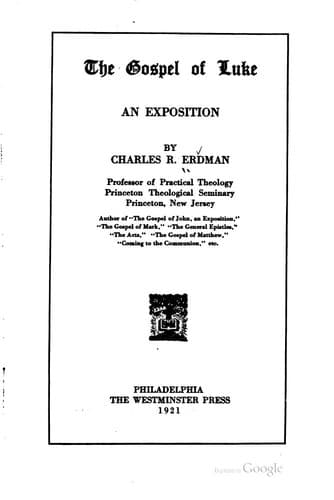
The Gospel of Luke, an expositionErdman, Charles Rosenbury
Religion
The Gospel of Luke, an exposition
Erdman, Charles Rosenbury
Bible. Luke -- Commentaries
Only the most recent scholarship has vindicated the historic accuracy of
Luke in connecting the event with the decree of Augustus and with the
enrollment under Quirinius. However, these facts are mentioned by Luke not
so much to fix the date of the birth of Christ as to explain how this
occurred in Bethlehem when the home of his parents was in Nazareth. Only a
legal necessity would have made them willing to take such a journey at
such a time, but thus it appears that the emperor of the world was
concerned unconsciously in the fulfillment of divine prophecy concerning
the Saviour of the world. According to the imperial decree, Joseph left
Nazareth and with Mary, to whom according to Matthew he was not only
“betrothed” but married, journeyed to Bethlehem, five miles south of
Jerusalem, to be enrolled in his ancestral city. There is born their
promised Son. Their exclusion from the inn was not due to any lack of
hospitality; much less did it express hostility to Jesus; it was due
simply to the crowded condition of the town. However, it is suggestive of
the obscurity and discomfort and poverty of Joseph and Mary.
In view of his evident appreciation of the supreme importance of the birth
of Jesus, the account of Luke is almost startling in its brevity and
simplicity. However, with consummate art, after his own short statement of
fact, he allows divine messengers to give the interpretation and to
express the significance of the event. These messengers were angels. They
appeared to a group of shepherds who were “abiding in the field, and
keeping watch by night over their flock.” Out of a blaze of heavenly glory
came the tidings of great joy to Israel, “There is born to you this day in
the city of David a Saviour, who is Christ the Lord.” The angel did not
then disclose the larger truth, that this Christ was to be the redeemer of
all men or that he was a divine Lord. However, a sign was given whereby
the shepherds might be able to distinguish the child and to be assured
that he was the Christ: “Ye shall find a babe wrapped in swaddling
clothes, and lying in a manger.” A strange sign it was; yet for us it has
become a symbol full of meaning; a Redeemer who was cradled in a manger
has known what it is to endure poverty and suffering and neglect, and now
he can sympathize with the lowly and distressed even as he is abundantly
able to save.
Public-domain text, read in full here on John Shaqi.
Reviews
Reviews
No reviews yet
Be the first to share your thoughts on this work.
Join the Discussion
Join the discussion
Sign in to leave a comment or review.
Sign InorCreate an account