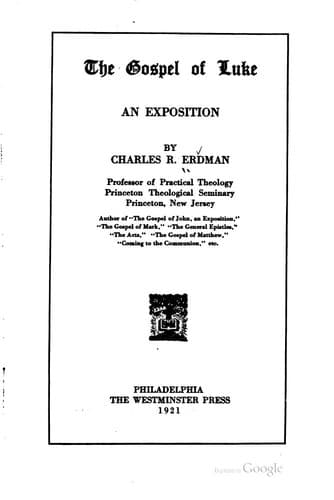
The Gospel of Luke, an expositionErdman, Charles Rosenbury
Religion
The Gospel of Luke, an exposition
Erdman, Charles Rosenbury
Bible. Luke -- Commentaries
33 And his father and his mother were marvelling at the things
which were spoken concerning him; 34 and Simeon blessed them, and
said unto Mary his mother, Behold, this _child_ is set for the
falling and the rising of many in Israel; and for a sign which is
spoken against; 35 yea and a sword shall pierce through thine own
soul; that thoughts out of many hearts may be revealed. 36 And
there was one Anna, a prophetess, the daughter of Phanuel, of the
tribe of Asher (she was of a great age, having lived with a
husband seven years from her virginity, 37 and she had been a
widow even unto fourscore and four years), who departed not from
the temple, worshipping with fastings and supplications night and
day. 38 And coming up at that very hour she gave thanks unto God,
and spake of him to all them that were looking for the redemption
of Jerusalem. 39 And when they had accomplished all things that
were according to the law of the Lord, they returned into Galilee,
to their own city Nazareth.
40 And the child grew, and waxed strong, filled with wisdom: and
the grace of God was upon him.
The incidents of the infancy of Jesus recorded by Luke not only add human
interest to the story but they interpret the future career and the saving
work of our Lord. Thus when on the eighth day he was named “Jesus,” a name
often given to Jewish boys, it was because he was destined to fulfill all
that the name implies, for he was to be the “Salvation of the Lord.”
So, too, when five weeks later he was presented in the Temple, when his
mother offered for herself a sacrifice which indicated lack of wealth but
not abject poverty, the real significance of the scene is set forth in the
prophetic utterances of the saintly Simeon and Anna. The first of these
utterances was the song of Simeon, called from the Latin form of its
opening words the Nunc Dimittis (“Now Lettest Thou Depart”). To this
devout soul it had been revealed that he should not die until he had seen
the Messiah, “the Lord’s Christ.” Led by the Spirit to the Temple while
the parents of Jesus are there presenting their Son before the Lord, he
took the little babe in his arms and sang the sweetest and most solemn
song of the nativity, which, unlike the Magnificat or the Benedictus,
promises redemption not only to Israel but to all the world.
Public-domain text, read in full here on John Shaqi.
Reviews
Reviews
No reviews yet
Be the first to share your thoughts on this work.
Join the Discussion
Join the discussion
Sign in to leave a comment or review.
Sign InorCreate an account