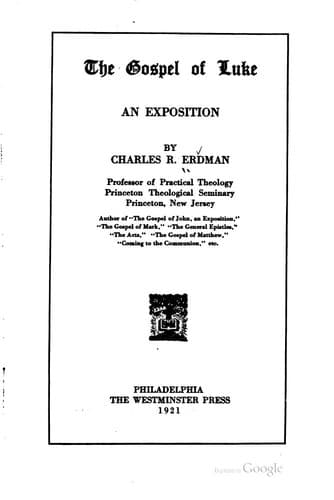
The Gospel of Luke, an expositionErdman, Charles Rosenbury
Religion
The Gospel of Luke, an exposition
Erdman, Charles Rosenbury
Bible. Luke -- Commentaries
whom little is forgiven, _the same_ loveth little. 48 And he said
unto her, Thy sins are forgiven. 49 And they that sat at meat with
him began to say within themselves, Who is this that even
forgiveth sins? 50 And he said unto the woman, Thy faith hath
saved thee; go in peace.
The Gospel of Luke appears to place special emphasis upon the grace and
forgiveness manifested by Jesus. It alone records his sympathy with the
sorrowing widow of Nain, and it is also alone in expressing the sympathy
which Jesus felt for the sinful woman who anointed his feet in the house
of Simon, the Pharisee. It is a picture, however, not only of the loving
mercy of our Lord, but of the unbounded gratitude felt by one who truly
appreciated the priceless gift of his pardoning grace.
By an unfortunate error of interpretation this woman has been confused
with Mary of Magdala or with Mary of Bethany. These three persons should
be, however, absolutely distinct. It is true that Jesus delivered the
first of these from demoniac possession, and that the second, like the
woman in this story, anointed his feet with perfume, but there is every
reason for believing that of the three only this woman was reputed to be a
sinner. She seems to have met Jesus on some previous occasion, to have
repented of her sins, and to have received from the Lord his word of
forgiveness.
It was her gratitude which gave her courage to enter unbidden into the
house of Simon, where Jesus was being entertained as a guest. She had come
to anoint his feet but as she beheld him, she thought again of her sins
and her hot tears of penitence fell upon the feet of her Lord. She hastily
unbound her hair and with it dried his feet and then poured upon them a
flask of fragrant ointment. No truer expression could have been given to
her gratitude and passionate devotion. The fact that Jesus allowed a woman
of such notorious character to express her love for him made Simon
conclude that Jesus could not be a prophet, for otherwise he would have
been able to discern the nature of so depraved a woman.
Public-domain text, read in full here on John Shaqi.
Reviews
Reviews
No reviews yet
Be the first to share your thoughts on this work.
Elsewhere in the archive
Join the Discussion
Join the discussion
Sign in to leave a comment or review.
Sign InorCreate an account