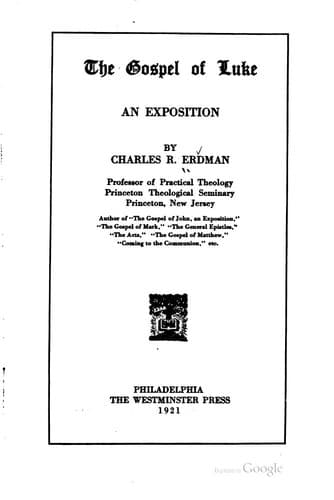
The Gospel of Luke, an expositionErdman, Charles Rosenbury
Religion
The Gospel of Luke, an exposition
Erdman, Charles Rosenbury
Bible. Luke -- Commentaries
By his reply Jesus showed his ability to read even the secret thoughts of
his host. The words of Jesus not only answered the silent criticism of
Simon but also rebuked him for his own impenitence and lack of faith.
Jesus proposed to his host a parable of two forgiven debtors, illustrating
the fact that gratitude depends upon the realization of the amount which
has been forgiven, and then he applied this principle to Simon and to the
woman whom Simon had been regarding with scorn. Jesus showed how keenly he
had felt the lack of love shown him by his host, and he contrasted it with
the affection shown by the woman. When he had entered the house Simon had
neglected the customary service of providing a bath for his feet; the
woman had washed his feet with her tears. Simon had withheld the kiss with
which a host usually welcomed his guests; the woman had passionately
kissed his feet. Simon had not furnished the perfume with which it was
usual to anoint an honored guest; the woman had come to the house with the
special purpose of pouring fragrant oil upon the feet of her Lord.
In view of the parable the message of Jesus is plain, “Wherefore I say
unto thee, Her sins, which are many, are forgiven; for she loved much; but
to whom little is forgiven, the same loveth little.” Jesus did not mean to
say that until now she had not been pardoned, nor yet that her pardon was
conditioned upon her love. He meant that her love resulted from her
pardon, and his words have been rightfully interpreted thus: “I say unto
thee that her many sins are forgiven, as thou mayest infer from this
exhibition of her love.” The remainder of the sentence was devoted to
Simon, “To whom little is forgiven, the same loveth little.” The words do
not prove that Simon had been pardoned; they rather indicate that his lack
of love had proved his lack of penitence and so of forgiveness. Jesus then
turned to the woman with a word of benediction: “Thy sins are forgiven.”
He thus assured her of the pardon previously granted, but still more he
vindicated her in the eyes of the guests and assured them of the new life
upon which the woman already had entered. They marveled as they heard him
pronouncing pardon. That is a divine function; but the ideal Man whose
sympathy Luke records was likewise the Son of God. Last of all, Jesus
turned to the woman with the final word of blessing: “Thy faith hath saved
thee; go in peace.” This is a clear statement of the fact that faith had
secured pardon and pardon had awakened gratitude and gratitude had been
expressed by a deed of devoted love. Such a penitent can rightfully go
away “into peace,” that is, to its present and continual enjoyment.
7. The Ministering Women. Ch. 8:1-3
Public-domain text, read in full here on John Shaqi.
Reviews
Reviews
No reviews yet
Be the first to share your thoughts on this work.
Elsewhere in the archive
Join the Discussion
Join the discussion
Sign in to leave a comment or review.
Sign InorCreate an account