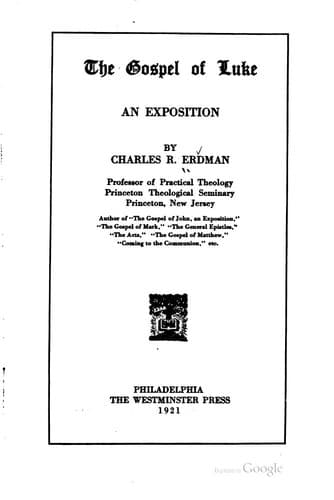
The Gospel of Luke, an expositionErdman, Charles Rosenbury
Religion
The Gospel of Luke, an exposition
Erdman, Charles Rosenbury
Bible. Luke -- Commentaries
1 And it came to pass soon afterwards, that he went about through
cities and villages, preaching and bringing the good tidings of
the kingdom of God, and with him the twelve, 2 and certain women
who had been healed of evil spirits and infirmities: Mary that was
called Magdalene, from whom seven demons had gone out, 3 and
Joanna the wife of Chuzas Herod’s steward, and Susanna, and many
others, who ministered unto them of their substance.
Luke writes the Gospel of womanhood. He alone records those tender
incidents in the lives of Elisabeth, Mary, and Anna which are associated
with the infancy of Jesus; he alone tells us of the widow of Nain whose
son Jesus restored to life; of the woman bowed down by Satan but relieved
by Jesus; of the penitent sinner who anointed his feet; of the domestic
scene in the home of Mary and Martha; of the woman who congratulated the
mother of Jesus; and of the women who condoled with him on his way to the
cross. Perhaps most significant of all is the statement of Luke that as
Jesus and his apostles moved about Galilee preaching the gospel, they were
attended by a company of women “who ministered unto them of their
substance.”
Among these women Luke mentions “Mary that was called Magdalene,” probably
so designated from the town of Magdala where formerly she had lived. By
this title she was distinguished from Mary the mother of Jesus, from Mary
of Bethany, and from other women of this same name.
It is a cruel error to confuse her with the sinful woman of whom Luke has
just been writing. Mary had suffered from demon possession, as here
stated, but there is nothing in the Gospels to indicate that she had ever
been a woman of notoriously evil life.
Luke also mentions Joanna, whose husband, Chuzas, had charge of the
household and personal estates of King Herod, evidently then a woman of
some social standing; but of her and her companions nothing further is
known, excepting this important fact, that their motive in ministering to
the Master was that of gratitude; they “had been healed of evil spirits
and infirmities.”
This statement by Luke is brief but illuminating. It throws light upon an
interesting question to which no other answer is given in the Gospels: How
did Jesus and his followers secure financial support during the years of
his ministry? Evidently those who had received from him spiritual help
gladly supplied his temporal wants and rendered to him all needful
service. Thus this passage indicates not only what Jesus did for women,
but what women did for him. It suggests a question: Who can estimate how
far the gifts and sacrifices of grateful women have been making possible,
through the passing ages, the preaching of the gospel in all the world?
8. The Parable of the Sower. Ch. 8:4-18
Public-domain text, read in full here on John Shaqi.
Reviews
Reviews
No reviews yet
Be the first to share your thoughts on this work.
Elsewhere in the archive
Join the Discussion
Join the discussion
Sign in to leave a comment or review.
Sign InorCreate an account