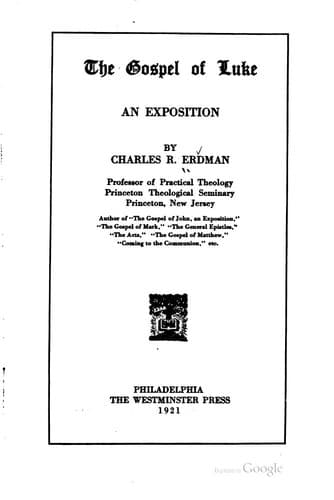
The Gospel of Luke, an expositionErdman, Charles Rosenbury
Religion
The Gospel of Luke, an exposition
Erdman, Charles Rosenbury
Bible. Luke -- Commentaries
This salvation was to be proclaimed to all the nations. Those to whom it
became known, and by whom it was accepted, were to become witnesses to the
transforming truth. For such testimony they would require courage and wide
sympathy and unfaltering faith, and in their courage and sympathy and
faith they would be like their Master who by such qualities was manifested
as the ideal Man as he was the divine Saviour of the world.
I. THE PREFACE TO THE GOSPEL. LUKE 1:1-4
1 Forasmuch as many have taken in hand to draw up a narrative
concerning those matters which have been fulfilled among us, 2
even as they delivered them unto us, who from the beginning were
eyewitnesses and ministers of the word, 3 it seemed good to me
also, having traced the course of all things accurately from the
first, to write unto thee in order, most excellent Theophilus; 4
that thou mightest know the certainty concerning the things
wherein thou wast instructed.
This preface is a perfect gem of Greek art; even in the English Version it
loses little, if anything, of its literary charm. As a prologue it is
regarded as unsurpassed for brevity, modesty, and dignity. However, its
value lies not in its beauty but in its testimony to the veracity of the
writer and to the historic worth and absolute credibility of the gospel
story. The fact of inspiration should not blind us to the human means by
which the Spirit of God secured accuracy in the communication of truth and
in the composition of the Holy Scriptures.
Here we are admitted to the study of a great historian. We see about him
his tools and his material; we are informed as to his motives and methods
in work, and are told of the qualifications he possesses for his great
task. First of all, he has before him many written accounts of the
ministry of Christ. He does not reject these as inaccurate but regards any
one of them as inadequate. By comparing and combining them he secures
valuable outlines for his more complete narrative.
Then, too, he intimates that he is living and writing amidst the scenes
and in the very atmosphere of the events he is recording; only recently,
as he indicates, have these “matters ... been fulfilled.” Again, he has
access to the testimony of men who were eyewitnesses of these events and
who have been public teachers of the gospel.
Further, he assures us of the absolute accuracy with which he has
investigated the incidents of the life and ministry of Christ, even from
the earliest scenes; he has sifted his material and weighed the evidence
and is to record only established facts.
These facts he is to relate “in order,” that is, in the sequence of time,
and further still, with the system and the careful regard to proportion
and to completeness which should characterize a scientific, historical
composition.
Public-domain text, read in full here on John Shaqi.
Reviews
Reviews
No reviews yet
Be the first to share your thoughts on this work.
Join the Discussion
Join the discussion
Sign in to leave a comment or review.
Sign InorCreate an account