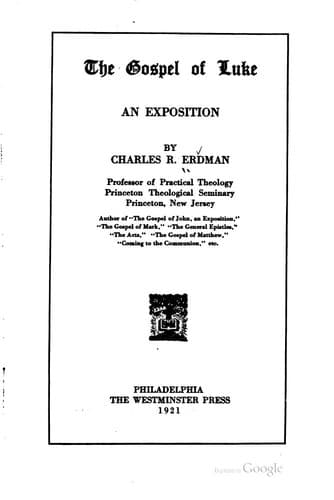
The Gospel of Luke, an expositionErdman, Charles Rosenbury
Religion
The Gospel of Luke, an exposition
Erdman, Charles Rosenbury
Bible. Luke -- Commentaries
5 And he said unto them, Which of you shall have a friend, and
shall go unto him at midnight, and say to him, Friend, lend me
three loaves; 6 for a friend of mine is come to me from a journey,
and I have nothing to set before him; 7 and he from within shall
answer and say, Trouble me not: the door is now shut, and my
children are with me in bed; I cannot rise and give thee? 8 I say
unto you, Though he will not rise and give him, because he is his
friend, yet because of his importunity he will arise and give him
as many as he needeth. 9 And I say unto you, Ask, and it shall be
given you; seek, and ye shall find; knock, and it shall be opened
unto you. 10 For every one that asketh receiveth; and he that
seeketh findeth; and to him that knocketh it shall be opened. 11
And of which of you that is a father shall his son ask a loaf, and
he give him a stone? or a fish, and he for a fish give him a
serpent? 12 Or _if_ he shall ask an egg, will he give him a
scorpion? 13 If ye then, being evil, know how to give good gifts
unto your children, how much more shall _your_ heavenly Father
give the Holy Spirit to them that ask him?
When the disciples came to the Master with the request, “Lord, teach us to
pray,” they had already, for some time, been with Christ in the school of
prayer, and they had been impressed by that most valuable of object
lessons, namely, the example of Christ himself. If in our minds doubt ever
arises as to the reality and efficacy of prayer, we need only turn to the
Gospel of Luke to be reminded that our Lord spent long hours in
intercession and that he prayed at every crisis in his life. Surely we
shall not be misled if we follow in his steps!
What the disciples wished, however, was some special form or formula for
prayer, such as John the Baptist seems to have given his followers. Jesus
replied by granting them a matchless model and then by encouraging them in
the assurance that prayer will surely be heard. This “Lord’s Prayer,” more
fully recorded by Matthew, was not intended as a form which must be used
rigidly on all occasions, but as a type which should mold all prayer,
however free and varied and spontaneous it may be.
The first word, “Father,” suggests the filial spirit in which all
believers should draw near to God, and it intimates much of the
encouragement which Jesus gave his disciples in the verses which
immediately follow this prayer.
Public-domain text, read in full here on John Shaqi.
Reviews
Reviews
No reviews yet
Be the first to share your thoughts on this work.
Elsewhere in the archive
Join the Discussion
Join the discussion
Sign in to leave a comment or review.
Sign InorCreate an account