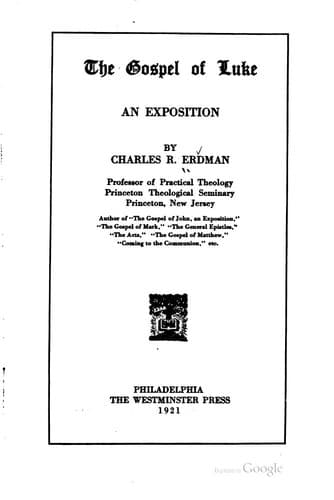
The Gospel of Luke, an expositionErdman, Charles Rosenbury
Religion
The Gospel of Luke, an exposition
Erdman, Charles Rosenbury
Bible. Luke -- Commentaries
The prayer contains five petitions, two relating to the cause of God in
the world, and three to personal needs of the petitioners. The first is a
request that the “name” of God, his revelation, or our conception of God,
be so reverenced, or so exalted, on earth as it is in heaven. The second
is a parallel request, namely, that his Kingdom may come. This Kingdom is
to be external, visible, glorious; it depends upon the inward
transformation of individuals, but it will yet appear in a perfected
social order, and in the universal reign of Christ. The next petition is
for “bread sufficient for our needs,” and it implies our right to pray for
all that concerns our physical welfare. We are then taught to pray for
pardon, as we come to God in a spirit of forgiveness toward others; and
lastly, to ask for continual protection from the snares of the Adversary
and from all the powers of evil.
To encourage his disciples in such petitions Jesus gave them the story of
the man whose ceaseless, almost shameless, asking secured for him the
answer to his request for needed bread. Jesus implied, however, that there
is, on the part of God, no such reluctance to be overcome, so that all who
“ask” of him will receive what they need; if they “seek” relief he will
grant it, if they “knock,” even at “midnight,” he will open the door
without delay.
Further still Jesus encouraged prayer by again reminding his hearers that
they were praying to a Father. Human parents reply to the requests of
their children, not by mocking them or with injurious gifts, not by giving
a stone when bread is asked, or a serpent for a fish, or a scorpion
instead of an egg. If then, with all our imperfections and limitations, we
know how to give good gifts to our children, much more can we expect our
heavenly Father to give his Holy Spirit, and so all other good if lesser
gifts, to them that ask him. Thus again we see that the blessed name of
“Father” is the key to the lesson. If we approach him as children it will
be with confidence, but also with submission, as we know that, whether he
gives or withholds, his reply will be an expression of infinite mercy and
of fatherly love.
7. Jesus Rebuking Blasphemy and Unbelief. Ch. 11:14-36
Public-domain text, read in full here on John Shaqi.
Reviews
Reviews
No reviews yet
Be the first to share your thoughts on this work.
Elsewhere in the archive
Join the Discussion
Join the discussion
Sign in to leave a comment or review.
Sign InorCreate an account