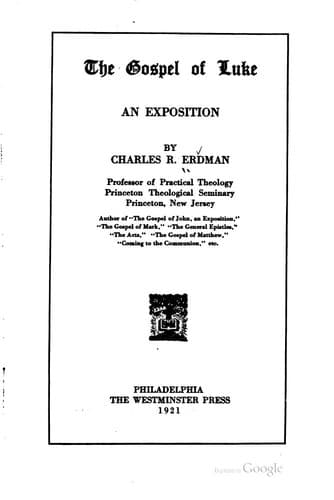
The Gospel of Luke, an expositionErdman, Charles Rosenbury
Religion
The Gospel of Luke, an exposition
Erdman, Charles Rosenbury
Bible. Luke -- Commentaries
42 But woe unto you Pharisees! for ye tithe mint and rue and every
herb, and pass over justice and the love of God: but these ought
ye to have done, and not to leave the other undone. 43 Woe unto
you Pharisees! for ye love the chief seats in the synagogues, and
the salutations in the marketplaces. 44 Woe unto you! for ye are
as the tombs which appear not, and the men that walk over _them_
know it not.
45 And one of the lawyers answering saith unto him, Teacher, in
saying this thou reproachest us also. 46 And he said, Woe unto you
lawyers also! for ye load men with burdens grievous to be borne,
and ye yourselves touch not the burdens with one of your fingers.
47 Woe unto you! for ye build the tombs of the prophets, and your
fathers killed them. 48 So ye are witnesses and consent unto the
works of your fathers: for they killed them, and ye build _their
tombs_. 49 Therefore also said the wisdom of God, I will send unto
them prophets and apostles; and _some_ of them they shall kill and
persecute; 50 that the blood of all the prophets, which was shed
from the foundation of the world, may be required of this
generation; 51 from the blood of Abel unto the blood of Zachariah,
who perished between the altar and the sanctuary: yea, I say unto
you, it shall be required of this generation. 52 Woe unto you
lawyers! for ye took away the key of knowledge: ye entered not in
yourselves, and them that were entering in ye hindered.
53 And when he was come out from thence, the scribes and the
Pharisees began to press upon _him_ vehemently, and to provoke him
to speak of many things; 54 laying wait for him, to catch
something out of his mouth.
The conflict between Jesus and his enemies here reached its climax. He
rebuked their hypocrisy, and pronounced upon them six solemn woes. His
words are full of warning for his followers in all ages; religion ever
tends to become a matter of form and ritual; hypocrisy is often
unconscious; its practice is almost universal.
A Pharisee whose heart was foul with sinful thoughts wondered that Jesus
had sat down to eat without first washing his hands according to the
Jewish ritual. No such ceremony was required by the Law, but only by the
traditions upon which the Pharisees laid such stress. Jesus declared that
to wash the body while the heart is impure is as absurd as to cleanse the
outside of an unclean cup or platter. He declared that God who made the
body created the soul also, and that God is more concerned with the latter
than with the former. He insisted that while it may be well to wash the
hands, a better preparation for a meal would consist in filling the heart
with love, which might be expressed in gifts to the poor. It was much more
important that the Pharisee should take the hatred from his heart, than
that Jesus should wash his hands. Vs. 37-41.
Public-domain text, read in full here on John Shaqi.
Reviews
Reviews
No reviews yet
Be the first to share your thoughts on this work.
Elsewhere in the archive
Join the Discussion
Join the discussion
Sign in to leave a comment or review.
Sign InorCreate an account