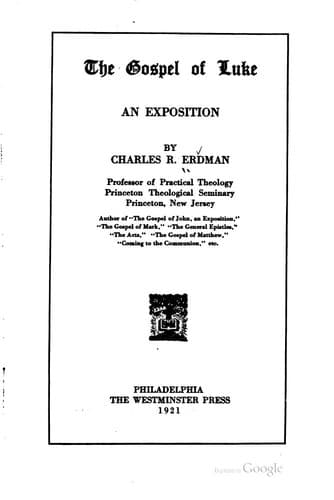
The Gospel of Luke, an expositionErdman, Charles Rosenbury
Religion
The Gospel of Luke, an exposition
Erdman, Charles Rosenbury
Bible. Luke -- Commentaries
Hypocrisy, however, is ever concerned with external forms while
disregarding realities. Therefore Jesus pronounced a woe upon the
Pharisees for tithing the small garden herbs while neglecting justice
toward men and love toward God, for observing some minute religious rite
while breaking all the Ten Commandments. Yet he did not condemn them for
caring for these trifles, but for neglecting things essential. “These
ought ye to have done, and not to leave the other undone.” V. 42. Jesus
further rebuked the vanity and the desire for prominence and public
recognition which is at once a mark and a cloak of hypocrisy. V. 43. He
further compared the evil influence of hypocrites to the defiling contact
with a grave, which is level with the ground, upon which one may
unconsciously tread and so become ceremonially unclean. Men are not on
their guard against those who make loud boasts of religion. V. 44.
At this juncture a lawyer interrupted Jesus with the statement that these
severe denunciations seemed to include him and his associates. It was true
that most lawyers were Pharisees, but they were the professional teachers
of this sect, the recognized leaders of the party; and in denouncing all
Pharisees Jesus seemed to include even these proud expounders of the Law.
Jesus replied that religious teachers who are insincere, or who allow
their religion to become a mere matter of form, are most of all to be
rebuked. He pronounced upon them three woes: the first, for extracting
from the Law minute and burdensome requirements which they were not
careful to observe themselves. It is a grievous fault for students and
scholars to make religion a matter of weariness and distaste, instead of a
delight to the common people. Vs. 45, 46.
Secondly, Jesus rebuked their heartless cruelty and fanaticism. Teachers
of religion are ever tempted to become bitter partisans, and even to have
a share in killing the very prophets and apostles of God. The hatred of
Jesus shown by his enemies was like that of their fathers who had killed
the divine messengers of old. The blood of these martyrs, from the first
to the last mentioned in the Hebrew Bible was yet to be required of the
nation, and those who rejected Jesus would partake in the judgment as they
were partakers of the crime, vs. 47-51.
Public-domain text, read in full here on John Shaqi.
Reviews
Reviews
No reviews yet
Be the first to share your thoughts on this work.
Elsewhere in the archive
Join the Discussion
Join the discussion
Sign in to leave a comment or review.
Sign InorCreate an account