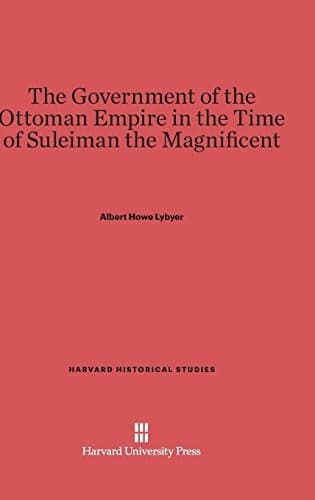
The government of the Ottoman Empire in the time of Suleiman the MagnificentLybyer, Albert Howe
History
The government of the Ottoman Empire in the time of Suleiman the Magnificent
Lybyer, Albert Howe
Süleyman I, Sultan of the Turks, 1494 or 1495-1566; Turkey -- Politics and government
The whole institution kept itself in power, and defended and enlarged the
empire, by being organized as an army. With exceptions, all its officers
of government were soldiers and all its army officers had governmental
duties. It constituted a standing army of cavalry and infantry, aided
by artillery, commissary, and transport services; and it controlled a
much larger feudal and irregular army. Through the feudal army it kept
the country in subjection. By garrisons it held the towns quiet. In case
of rebellion, it threw a great force upon the insurgents, and beat them
down with cruel and resistless energy. For foreign wars it gathered
an enormous but well-controlled host, which was victorious in battle
throughout the reign of Suleiman. It took by siege Belgrade and Rhodes,
but it failed at Vienna and Malta. The weakness of the Ruling Institution
as an army was its essential indivisibility. Only one great war could be
waged at a time, although there were great enemies in two directions;
hence an overwhelming defeat of the principal army would have been
irreparably disastrous. But the army was to suffice for a long period;
and for generations its worst foes were to be, not foreign armies, but
internal rivalries and departures from its constitutive principles.
To maintain the pomp and ceremony which are attached to the idea of an
empire, especially in the East, and to supply the sultan on a large
scale with all the enjoyments which were considered due to his state,
the Ottoman Ruling Institution was in another aspect a great court
and household. Nearly all its members shared in the display of grand
occasions, many went to the hunt with the sultan, and a large proportion
of them had constant duties of ceremonial and personal service. Suleiman
was known as the Legislator and the Conqueror, but beyond both these
titles as the Magnificent; he shone as head of the government and the
army, but still more as head of the court. Splendor and luxury, however,
are expensive, and in the end his example was to be ruinous.
All the members of the Ruling Institution were set off as a nobility by
exemption from taxation and by special jurisdiction; but, lest they might
prove a danger to the institution, they were not allowed to transmit
their nobility to their descendants. In the end, however, their special
privilege was to become so desirable that the walls of separation would
be invaded and the institution would be wrecked.
Public-domain text, read in full here on John Shaqi.
Reviews
Reviews
No reviews yet
Be the first to share your thoughts on this work.
Elsewhere in the archive
Join the Discussion
Join the discussion
Sign in to leave a comment or review.
Sign InorCreate an account