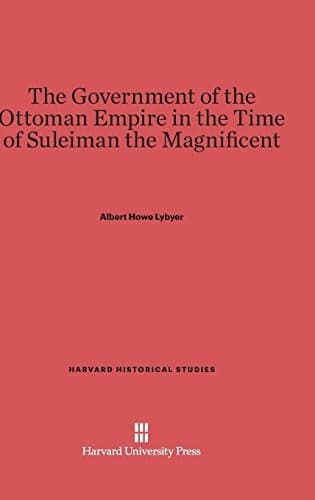
The government of the Ottoman Empire in the time of Suleiman the MagnificentLybyer, Albert Howe
History
The government of the Ottoman Empire in the time of Suleiman the Magnificent
Lybyer, Albert Howe
Süleyman I, Sultan of the Turks, 1494 or 1495-1566; Turkey -- Politics and government
The dominance of the Mongols was based on the discipline of an army
of freemen who were intelligent enough willingly to render absolute
obedience to their officers as the well-tested condition of certain
success. With the break-up of the vast Mongol Empire, the lands now in
Russian Central Asia, Afghanistan, and Persia lapsed toward the horde
organization of nomad Tatars, but became more and more modified by Moslem
feudalism. Under such conditions, Timur, high-born and adventurous,
chivalrous and literary, fanatical and cruel, achieved an empire that
was large and splendid, but personal to himself, and destined to vanish
almost with its founder. Yet he presaged a time when in Asia and Europe
alike there should come, after the disintegrating individualism of the
fourteenth and fifteenth centuries, a period of the gathering together of
lands and peoples into large units under strong personal governments.
Baber, descendant of Timur in the sixth generation, descendant also of
Genghis Khan, came at the beginning of the new era. Less ruthless than
either of his great ancestors, less legal than the “Inflexible One,”
less Moslem than the “Scourge of Asia,” but possessed of much of the
leadership and military genius of both, he stands forth, by reason of
his memoirs, as one of the best known conquerors of history. His love
of carousing, his family affection, his literary bent, his toleration of
heretics and infidels, his bold leadership, his liberality in dividing
spoil, presented qualities and suggested modes of activity which were to
characterize all his descendants down to the puritanical Aurangzeb.
Public-domain text, read in full here on John Shaqi.
Reviews
Reviews
No reviews yet
Be the first to share your thoughts on this work.
Elsewhere in the archive
Join the Discussion
Join the discussion
Sign in to leave a comment or review.
Sign InorCreate an account