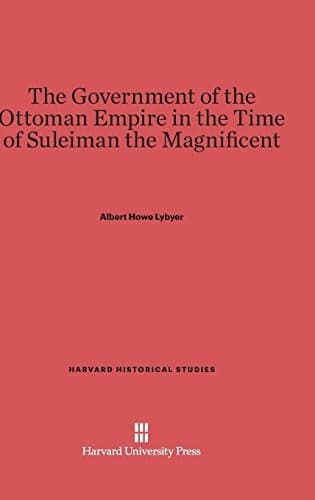
The government of the Ottoman Empire in the time of Suleiman the MagnificentLybyer, Albert Howe
History
The government of the Ottoman Empire in the time of Suleiman the Magnificent
Lybyer, Albert Howe
Süleyman I, Sultan of the Turks, 1494 or 1495-1566; Turkey -- Politics and government
Humayun set aside two days of the week for business of state. Drums were
beaten to summon officials and give notice that the hall of audience
was open. Any subject might appear and ask for justice. Suits of fine
apparel and purses of money were at hand to reward the worthy, and
executioners stood by with drawn swords to punish the guilty. Guns were
fired at the close of the audience to notify officials that they might
retire. Aurangzeb held general court in the great hall of audience for
two hours on regular days. Persons who had petitions to present held
them up, and these were taken by the emperor, read by him, and often
granted on the spot. On at least one day in the week he sat with the two
_Kazis_ of the city, and on another day he heard privately ten cases of
persons of low rank. In the evening the chief officers were commanded
to be present in a smaller hall, where Aurangzeb sat to “grant private
audiences to his officers, receive their reports, and deliberate on
important matters of state.” This gathering resembled the Divan of
Suleiman, but it lacked most of the latter’s judicial work; in India such
work was done by the chief judges sitting separately, or by the emperor
in the great audiences. Furthermore, it was the sovereign and not a grand
vizier who presided in this council. The assembly was deliberative in
matters of policy and general administration, and judicial in that it had
jurisdiction of cases which involved officers of high rank.
For purposes of local government the empire was divided into _subahs_,
or provinces, each under a _Nawab_ (a plural of majesty, from _naib_,
often called “nabob” by Westerners), or governor. Under Akbar the number
of _subahs_ varied from fifteen to eighteen. Like the _Beylerbeys_ of
the Ottoman Empire, the _Nawabs_ tended to increase in number, the size
of their provinces diminishing accordingly. The _Nawab_ was almost a
little emperor in his province. He held audiences, commanded the army,
conferred lesser titles, appointed and dismissed most officials, and
was the highest judicial authority. His power was limited, however, by
the emperor’s right to recall him, by the right of appeal in judicial
cases from him to the emperor, and by the fact that the financial and
judicial officers were separately appointed and were responsible only to
the throne. The _Nawab_ and his court were supported by lands granted
in _jagir_. He might suspend the _jagirs_ of officers pending imperial
decision. He was responsible for the security and order of his province,
and had _Faujdars_ under him in the several districts, who exercised
military command and the powers of chief of police and police judge,
their position resembling somewhat that of the _Sanjak Beys_ of the
Ottoman system. The chief financial officers in each province were the
_Diwans_, who, as explained above, collected the imperial revenue and
had oversight of all lesser revenue officers. They and their deputies
Public-domain text, read in full here on John Shaqi.
Reviews
Reviews
No reviews yet
Be the first to share your thoughts on this work.
Elsewhere in the archive
Join the Discussion
Join the discussion
Sign in to leave a comment or review.
Sign InorCreate an account