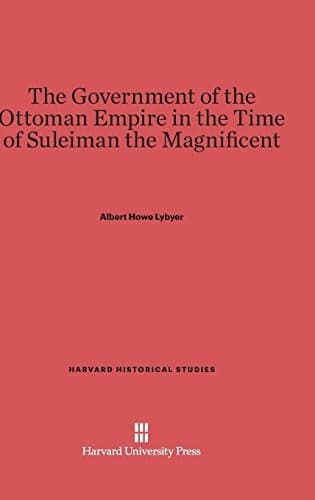
The government of the Ottoman Empire in the time of Suleiman the MagnificentLybyer, Albert Howe
History
The government of the Ottoman Empire in the time of Suleiman the Magnificent
Lybyer, Albert Howe
Süleyman I, Sultan of the Turks, 1494 or 1495-1566; Turkey -- Politics and government
possessed judicial powers in cases concerning finance and land titles.
The chief judge of the province, subject however to appeals to the
governor, was the _Nizam_. He heard the serious criminal cases, and his
deputy, the _Daroga Adaulat al Aulea_, attended to most of the important
civil ones. Local _Kazis_, aided by _Muftis_, _Mohtesibs_, and _Kutwals_
or mayors, kept order in the smaller cities and districts. _Rajahs_ who
had made terms with the emperor exercised powers very similar to those
of the _Nawabs_. Their positions were secured by heredity, however, and
in their provinces the imperial financial and judicial officers had no
jurisdiction. They simply owed military service and a certain amount
of tribute, failing in which they might be reduced by force of arms.
The Ottoman system contained no subjects who were at once so secure of
their positions, so nearly independent, and so powerful as the _Rajahs_.
Kurdish, Albanian, and Arabian chieftains were perhaps as secure and as
independent, but they were of very small wealth and might; while the
Voivodes of Wallachia and Moldavia were not so secure or so independent.
The condition of the common people under this government is to be known
mainly by inference. Various documents and acts show the benevolent
intentions of emperors and high officials toward the masses. Whether from
wise prevision or from genuine charitable feeling, there appears to have
been much solicitude lest the cultivators of the soil should be reduced
to utter penury or driven from their lands. Akbar, for instance, issued
strict orders that on military expeditions nothing should be taken
from the people without careful assessment and immediate or subsequent
payment. Nevertheless, at the best the result of the general policy
was to leave the cultivator little more than a bare living. The whole
system drained away wealth to a few great cities and a comparatively
few persons. If but few complaints rose from the masses, it was because
their lot was no worse than that of their forefathers had been for many
generations. Aside from the periods of civil war, the Moguls gave peace
and order. Akbar removed internal tolls two centuries before such a thing
was accomplished in France, and thus made of the land a single economic
unit, with the result that in his reign India as a whole enjoyed such
prosperity as she has known at very few other periods in her history.
Public-domain text, read in full here on John Shaqi.
Reviews
Reviews
No reviews yet
Be the first to share your thoughts on this work.
Elsewhere in the archive
Join the Discussion
Join the discussion
Sign in to leave a comment or review.
Sign InorCreate an account