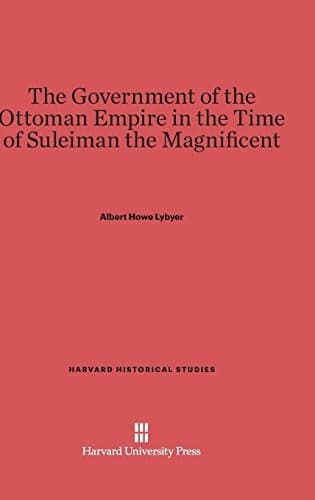
The government of the Ottoman Empire in the time of Suleiman the MagnificentLybyer, Albert Howe
History
The government of the Ottoman Empire in the time of Suleiman the Magnificent
Lybyer, Albert Howe
Süleyman I, Sultan of the Turks, 1494 or 1495-1566; Turkey -- Politics and government
[751] Junis Bey, below, p. 266, says that the _Kiaya_ of the Janissaries
has 300 ducats of feudal grant per year, which would equal about 15,000
aspers.
[752] “_Giannizzeriasis._”
[753] “_Livreri._”
[754] “_Bracchi._”
[755] “_Assareri._”
[756] This Slavonic word seems to be used here simply in the sense of
“army officers.”
[757] “_Immensi._”
[758] This is an error. Probably the number intended is three hundred.
Junis Bey, below, p. 267, gives two hundred and fifty.
[759] Only two officers should be named here. The lieutenant
(_Protogero_) and the _Kiaya_ were the same. Junis Bey gives this
correctly.
[760] Under each _Agha_, or chief officer.
[761] The _Kiaya_ and the lieutenant are the same.
[762] This derivation is from a secondary meaning; the primary meaning is
“foreign youth.” See above, pp. 98, 99, note 1.
[763] “_Bracor-bashi._”
[764] This should read “_Kiaya_ and secretary.”
[765] “_Brene._”
[766] This is the common report in Western writers as regards the
_Peiks_. See Menavino, 155; Nicolay, 100.
[767] _Kiayas_ and secretaries.
[768] This refers to those whom Junis Bey, below, p. 268, calls
_Zainogiler_, a body of lancers, who are here erroneously classed with
the falconers. Junis Bey’s figures are 20,000 in all, 1000 receiving pay
in money. Are they the Voinaks (above, p. 131)?
[769] Junis Bey, “_cursor_,” a messenger or porter.
[770] Literally, “intendant of the town.”
[771] Junis Bey says 57.
[772] Usually called by Western writers “Dragoman.”
[773] This was the “Old Palace” of Mohammed the Conqueror, and stood
where the _Seraskierat_, or War Office now stands.
[774] Suleiman is said to have been faithful to Roxelana after he had
made her his wife. See above, p. 56.
[775] This should read “per day.” Junis Bey, below, p. 269.
[776] This should read 100,000: _ibid._
[777] Junis Bey, below, p. 270, says 200,000 per year.
[778] At the meetings of the Divan.
[779] This should read fifty each: Junis Bey, below, p. 271.
[780] “_Che fanno fattione._”
[781] This should read “ten thousand”: Junis Bey, below, p. 272.
[782] Of the Turkish possessions in Asia.
[783] “_Maldac._”
[784] “_Esdum._” Junis Bey, below, p. 272, has “_exdrun_.”
[785] More correctly, _Irak Ajam_, north-central Persia.
[786] Junis Bey, 273, counts these as two, and the whole number as
thirty-six.
[787] Herzegovina.
[788] “_Cangri._”
[789] “_Hallayce_” or “_Allaye_.”
[790] The ancient Magnesia.
[791] The plain of Albistan.
[792] “_Alziden._”
[793] Evidently the writer intended to fill these in, but failed to
secure the names.
[794] This amounts to about four million ducats a year.
[795] The reference is, of course, to the feudal _Spahis_ and their
officers, who then received according to this estimate two-thirds of the
revenues of the empire.
[796] At this point the smaller type begins. See below, p. 315.
Public-domain text, read in full here on John Shaqi.
Reviews
Reviews
No reviews yet
Be the first to share your thoughts on this work.
Elsewhere in the archive
Join the Discussion
Join the discussion
Sign in to leave a comment or review.
Sign InorCreate an account